3D-printed structures use embedded logic to respond to environment
Siobhan Treacy | January 22, 2019Researchers from the University of Pennsylvania’s School of Engineering and Applied Science have created responsive structures with embedded logic, without any kind of electronic system or batteries.
The new structures use physical and chemical makeup to find the right response to the environment, without batteries, motors, circuits or processors. The structures can switch between different reactions based on what is around them, like humidity or chemical-based oils.
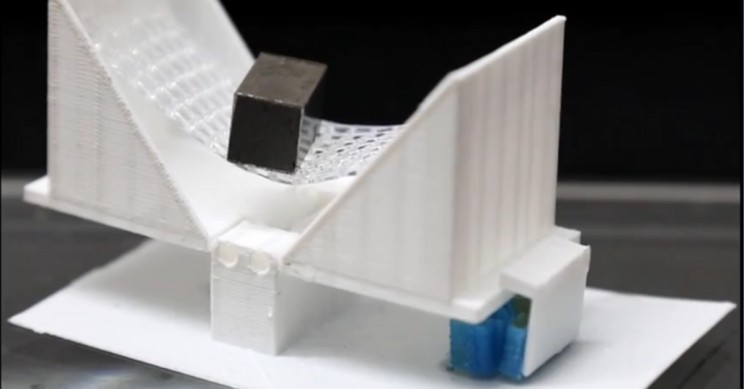 This is one of the structures that was created using multimaterial 3D printing (Source: University of Pennsylvania)
Active structures made with silicone are oil-absorbing, and change when exposed to oil. Structures made with hydrogels are water-absorbing and react differently when exposed to water. Developers can even add heat and light-sensitive materials to add another level of shapeshifting to the structure.
Before the new research, the team 3D-printed bistable lattices of angled silicone beams. When the beams are pressed, they lock together and they easily pull back into expanded form. The new structures have the same bistable behavior, which is dependent on the angle, length and width of the beams.
"Compressing the lattice stores elastic energy in the material. If we could controllably use the environment to alter the geometry of the beams, the structure would stop being bistable and would necessarily release its stored strain energy. We needed a way to restrict expansion to one direction only,” said Jordan Raney, assistant professor in Penn Engineering’s Department of Mechanical Engineering and Applied Mechanics and leader of the study.
The team infused 3D-printed structures with glass and cellulose fibers that run along the beams. The fibers stop the beams from stretching too much while allowing them to expand and increase in width.
The actuators are created by changing the length or width of the added internal fibers. The fibers enable the actuators to have a different sensitivity than the rest of the structure.
That is a lot of materials packed into one structure, which would typically be difficult to reproduce. That is where 3D printing comes in. Multi-material 3D printing allows many materials to be printed at once. One structure can have many shape-shifting materials printed in different areas in one print. Without multi-material 3D printing, creating a structure like this would take longer and require more than one printing session.
The inspiration behind the project was a plant, the Venus flytrap. The Venus flytrap can make movement decisions without a brain or nervous system, like snapping closed when a fly lands on it. This ability sparked the researchers' interest. What if they could create moving structures that react to their environment?
Before these structures were created, the research team was studying two topics. The first was bistable structures with one or two indefinite configurations. The second topic was responsive materials that can change shape under specific circumstances. Embedded logic brought both of these ideas together to create the new structures.
“The new approach uses multi-material 3D printing to bridge across these separate fields so that we can harness material responsiveness to change our structures' geometric parameters in just the right ways,” says Raney.
The researchers say that this method could be used to achieve more complicated shapeshifting as well, just by changing the material the structure is made out of.
The team has created an artificial Venus flytrap that closes when pressed and a box that opens only when exposed to oil and water.
The paper on the new structures was published in Nature Communication.