Historical emissions trends updated with the Community Emissions Data System
S. Himmelstein | January 22, 2019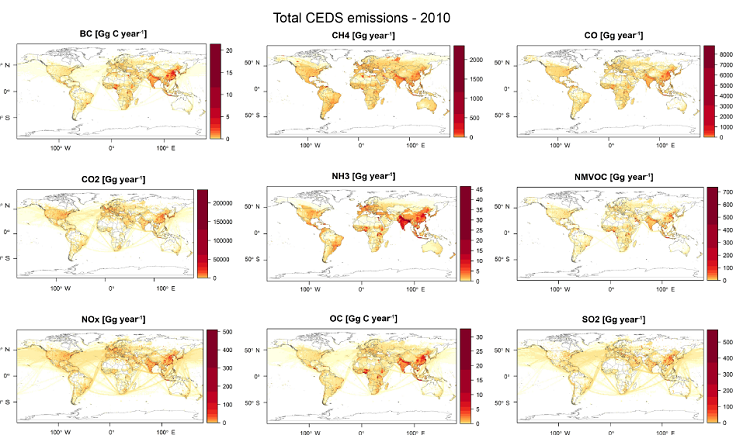 Total gridded CEDS emissions by emission species for 2010. Source: CEDS
An international team of researchers has assembled an updated global historical emission data set to meet the needs of the global atmospheric modeling community and others for consistent long-term emission trends. The Community Emissions Data System (CEDS) covers the years 1750 to 2014 for carbonaceous aerosols and chemically reactive gases.
The initiative has helped to address the diversity of existing emissions inventory estimates with a reproducible approach applied to all emissions types and updated emissions factors. The system provides annual estimates of carbon monoxide, methane, ammonia, oxides of nitrogen, sulfur dioxide, and non-methane volatile organic compounds, carbonaceous aerosols, and carbon dioxide by country, fuel and sector, along with seasonal data. Population, energy consumption and other economic driver data are combined with national and global emissions inventory data to produce consistent emissions trends over time.
Emissions prior to 1850 are dominated by residential biomass burning and agricultural emissions. Industrialization saw an increase in energy-, industry- and transportation-related emissions, with a rapid increase in pollution levels observed in the mid-20th century. Emissions of some species began to slow or see global reductions in the late 20th century with the introduction of emission control policies, but emissions of many of those species increased again in recent years due to increased economic activity in rapidly industrializing regions.
The software and data used to develop CEDS will be publicly available through an open-source repository to facilitate community involvement and improvement.
Researchers from Pacific Northwest National Laboratory, University of Maryland, International Institute for Applied Systems Analysis (Austria), European Commission (Italy), Oak Ridge National Laboratory, University of Illinois at Urbana-Champaign, Comision Nacional de Energia Atomica (Argentina), Japan Environmental Sanitation Center, Tsinghua University (China) and Argonne National Laboratory contributed to this study, which is published in Geoscientific Model Development.