Nvidia Making Fake Faces with Machine Learning
Marie Donlon | December 20, 2018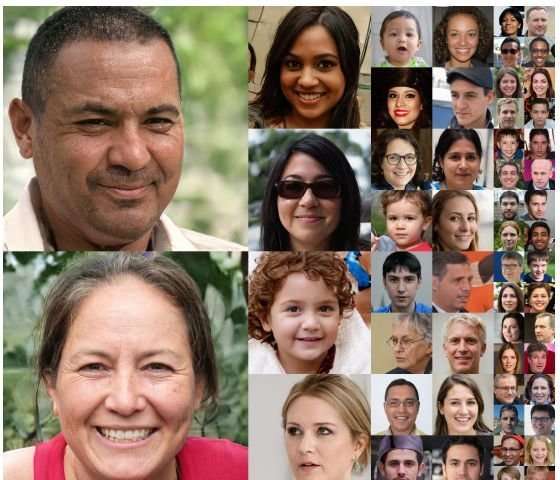 Images produced by the generator. Source: NVIDIAUsing a new type of generative adversarial network (GAN) technique, a team from tech company Nvidia created realistic images of people who do not actually exist.
"We came up with a new generator that automatically learns to separate different aspects of the images without any human supervision," the researchers said. "The new architecture leads to an automatically learned, unsupervised separation of high-level attributes."
The work was featured in a paper titled “A Style-Based Generator Architecture for Generative Adversarial Networks,” which appears in the journal arXiv. The research team composed of Tero Karras, Samuli Laine and Timo Aila focused on creating a GAN that learns to create an entirely new image based on its exposure to real images. In other words, they created images of people who are not real based on images of real individuals.
The work is not completely novel: similar technology does exist and in recent weeks a team of researchers developed synthetic fingerprints using a similar machine learning algorithm. But Nvidia is credited with creating images that were described by some as “startlingly real.”
A machine learning concept that emerged in 2014, generative adversarial networks involve two neural networks pitted against one another. The first neural network is the generator that studies a database of images — people in this case — and then attempts to recreate those images. It is then up to the other network, the discriminator, to determine if those images are real or fake.
Initially, the generator may not successfully recreate those images, making the job of the discriminator easier in terms of locating fakes. Yet, with each successive attempt, the generator learns more and more, ultimately improving images with each attempt. This back and forth continues until the generator creates an acceptable rendering of, in this case, a person.
To create the fake images, the team experimented and played with elements such as race, gender and even details such as freckles. The style-based generator operates on a scale of coarse styles, middle styles and fine styles. Coarse style deals in poses, hair and face shape; middle style refers to facial features and eyes; and fine style refers to color scheme.
While the technique is being credited with successfully mimicking real people, there are obvious concerns about the technique, namely, that in this era of fake news, images can be convincingly faked.