Molecular Sieve Engineered for Hydrogen Storage
S. Himmelstein | December 12, 2018Greater diffusion of hydrogen fuel cell technology is dependent on the availability of suitable storage systems. A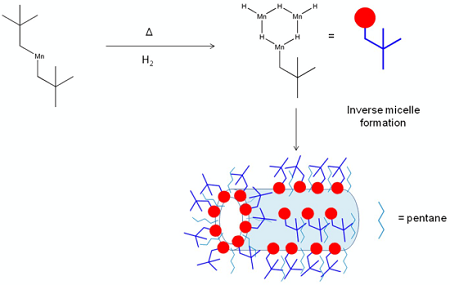 Schematic representation of manganese hydride molecular sieve nanostructure formation. Source: Skipper et al. materials-based approach pursued by an international research team has resulted in a manganese hydride molecular sieve easily synthesized from inexpensive precursors. The storage system demonstrates a reversible excess adsorption performance of 10.5 wt% and 197 kg hydrogen/m3 at 120 bar at ambient temperature with no loss of activity after 54 cycles.
The amorphous porous manganese hydride material functions as its own intrinsic nanoscale heat sink, minimizing or even eliminating external heat management requirements. The total energy storage costs for the molecular sieve are estimated to be about five times less than those for 700 bar tanks.
The storage device’s design and performance are expected to meet or surpass the U.S. Department of Energy’s system targets of 6.5 wt% and 50 kg hydrogen/m3 for 5 kg of hydrogen, the fuel volume required to sustain a 500 km driving range in a fuel cell vehicle.
Researchers from the University of South Wales, the University of Manchester, Hydro-Quebec Research Institute, the University of Sofia (Bulgaria), Paul Scherrer Institut (Switzerland), Texas Tech University and Lancaster University participated in this study, which is published in Energy & Environmental Science.