Powerpaste packs hydrogen for vehicular propulsion
S. Himmelstein | February 09, 2021The hydrogen economy is making inroads for automobiles, trucks and buses equipped with high-pressure fuel storage tanks and fuel cells that can be supplied at a growing number of filling stations. Such infrastructure is not available for scooters, motorcycles and other small vehicles, prompting researchers from the Fraunhofer Institute for Manufacturing Technology and Advanced Material (IFAM), Germany, to devise an infrastructure-independent hydrogen fuel solution.
Magnesium hydride-based Powerpaste stores the hydrogen at atmospheric pressure and room temperature, and is released as needed. The material carries 10 times the energy of a similar weight in 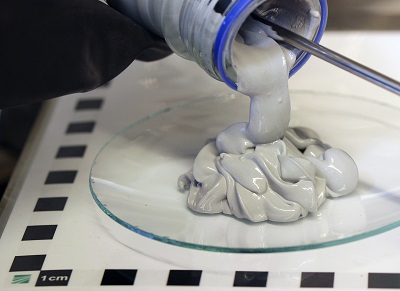 Powerpaste provides a high-density, safe and easily transportable source of hydrogen. Source: Fraunhofer IFAMlithium batteries and substantially more than a 700 bar hydrogen tank of the same weight. The researchers contend that vehicles operating with a Powerpaste powertrain can expect a range comparable to, or even greater than, gasoline.
Powerpaste is synthesized by combining magnesium and hydrogen at 350° C and five to six times atmospheric pressure to form magnesium hydride. An ester and a metal salt are added to complete the process and form a viscous gray goop that can be loaded into cartridges. A plunger mechanism propels the paste into a chamber where it reacts with water to release hydrogen at a controlled rate to feed a fuel cell and supply electrical power.
The researchers suggest that Powerpaste could also provide a fuel option for range extenders in battery-powered electric vehicles. Drones might also be able to extend flight times to several hours instead of 20 minutes.