
Video: MIT Develops a Solid-State Plane Powered by Ionic Wind
Peter Brown | November 30, 2018Modern airplanes are powered by burning fossil fuels in order to power combustion engines for flight. As the world moves more toward developing greener technologies to combat the impacts of client change, at some point airplane travel and commercial logistics will have to be addressed.
MIT engineers are already working toward this moment with a plane that was built and flown with no moving parts. Instead of propellers or turbines, the light aircraft is powered by ionic wind — a silent flow of ions that is produced on the plane and that generates enough thrust to propel the plane over a sustained flight.
MIT said the solid-state plane does not use fossil fuels like current aircraft and unlike drones has no propellers making it completely silent.
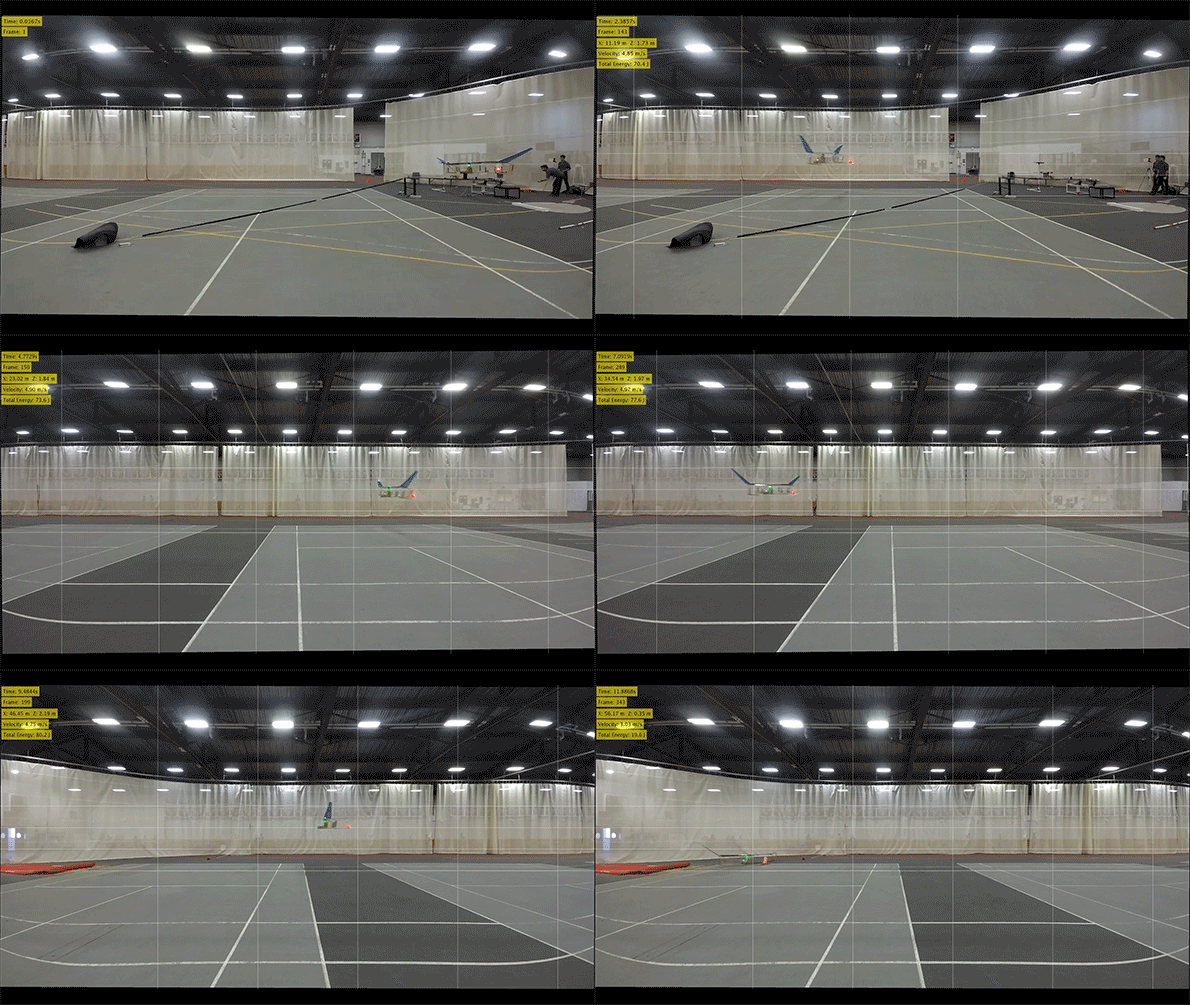 “This is the first-ever sustained flight of a plane with no moving parts in the propulsion system,” said Steven Barrett, associate professor of aeronautics and astronautics at MIT. “This has potentially opened new and unexplored possibilities for aircraft which are quieter, mechanically simpler, and do not emit combustion emissions.”
In the near term, the technology could be used to create silent drones but eventually, the ion propulsion system could be paired with more conventional combustion systems to create more fuel-efficient, hybrid passenger planes and other larger aircraft, MIT said.
Creating an Ion Cloud
The plane created by MIT resembles a lightweight glider that weighs about 5 pounds and has a 5-meter wingspan. It carries an array of thin wires that act as positively charged electrodes, while similarly arranged thicker wires, running along the back end of the plane’s wing, serve as negative electrodes.
The fuselage of the plane holds a stack of lithium-polymer batteries that supply 40,000 volts to positively charge the wires via a power converter. Once energized, the wires act to attract and strip away negatively charged electrons from surrounding air molecules. The air molecules that are left behind are newly ionized and are attracted to the negatively charged electrodes at the back of the plane.
This ion cloud flows toward the negatively charged wires, where each ion collides millions of times with other air molecules creating thrust and propelling the plane forward.
MIT tested the plan multiple times across the gymnasium in MIT’s DuPont Athletic Center where it flew a distance of 60 meters. The plane produced enough ionic thrust to sustain flight the entire time. The team repeated the flight 10 times with similar performance.
“This was the simplest possible plane we could design that could prove the concept that an ion plane could fly,” Barrett said. “It’s still some way away from an aircraft that could perform a useful mission. It needs to be more efficient, fly for longer and fly outside.”
The next steps are to increase the efficiency of the design, produce more ionic wind with less voltage and increase the design’s thrust density.
The full research can be found in the journal Nature.



Brought to you by our sponsors, the Sharper Image™.
In reply to #1
Seems steady enough in the still air of a gym, but how much of a cross-wind could it resist?
How much electrostatic discharge from a lightning strike in an electrical storm could it withstand?
5-pounds of weight over a 5-foot wingspan sounds interesting all by itself, though maybe a little flimsy...
I am not sure how this would work in condeensing conditions or rain.
Bottom line will be efficiency: How much thrust power do you get for a watt of electrical power? If that can even come close to the efficiency of an ICE or turbine, then they have something.
In reply to #4
Electrical power generation could be accomplished using 30 yo LFTR salt reactor feeding electric turbofans and ionic tech.
In reply to #4
Please see US Patent 10,119,527 and flight videos on Google.
How much energy did the bungee cord impart when launched? Could it take off on its own? Looks like most impetus for flight came from the bungee.
In reply to #5
Propulsion systems for aircraft without takeoff assistance (e.g. a catapult) are all sized for the takeoff and climb power condition. The power requirement for this phase of flight is nearly always much greater than at cruise, meaning the engines have to be big enough to get you airborne but then at cruise they're not working flat out.
What the team have done here is sized their propulsion system for cruise (making it lighter), just to prove they can stay afloat. They have then used a catapult to get airborne.
Cheaters using a catapult
In reply to #7
A good point, but they were outside in the prevailing wind at Kitty Hawk.
Surprisingly, the MIT ion propelled glider was NOT "the first ion propelled aircraft of any kind to carry its power supply," as Barrett claims in his paper and video. The real first such device to carry its power supply is called the "Self Contained Ion Propelled Aircraft." It is protected by US Patent 10,119,527, that has been in effect since 2014. It has a far higher power to weight ratio and efficiency level, than the MIT glider. You will find more than adequate substantiation for these facts online. www.electronairllc.o