Oroville Dam Spillway Is Ready for Winter
David Wagman | November 28, 2018Concrete on the main spillway at California's Oroville Dam is expected to have cured by early December, in time for the upcoming rainy season and use of the main spillway if necessary. Dry finishing, joint sealing, completing sidewall backfill and site clean-up on the main spillway was slated to continue.
The reconstructed spillway is now built to its original design capacity of 270,000 cubic feet per second, said the California Department of Water Resources (DWR).
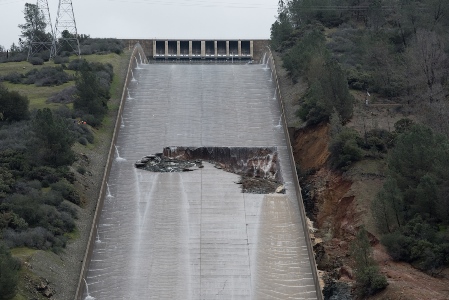 Photo from February 2017 showing damage to the dam's spillway. Source: California DWRThe final erosion-resistant concrete slab was placed on October 11. Crews placed a total of 378 structural slabs in 2018. Combined with work done in 2017, some 612 new concrete slabs were installed.
Final concrete placements on energy dissipaters at the base of the main spillway were completed on October 20, DWR said.
In addition, a roller-compacted concrete (RCC) splashpad was completed in late October. In that segment of the project, crews placed approximately 700,000 cubic yards of roller-compacted concrete on the splashpad. Crews also completed construction of the RCC buttress at the base of the emergency spillway.
Placement of a structural concrete cap connecting the RCC buttress to the dam's emergency spillway structure is expected to be complete in early 2019.
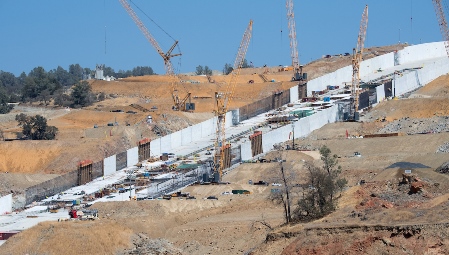 This September 2018 photo shows work progressing on the main spillway replacement project. Source: California DWRPlans call for the DWR to maintain lower-than-average lake levels behind the dam during the winter months to provide operational flexibility to ensure flood protection, meet water deliveries and environmental requirements and prevent use of the emergency spillway this winter. Construction will continue on the emergency spillway into early 2019.
In September, the DWR raised its cost estimate for emergency response and reconstruction of the main and emergency spillways at the Oroville Dam to $1.1 billion. DWR warned at the time that further cost adjustments could occur as work continues to complete repairs in 2019. The cost estimate is about $455 million higher than estimates made in 2017, shortly after the dam's spillway suffered damage.
A report released in early 2018 found that the spillway incident was caused by long-term, systemic failure of the DWR, regulatory and general industry practices to recognize and address design and construction weaknesses, poor bedrock quality and deteriorated service spillway chute conditions.