DARPA to Develop Qualification Technologies for 3D Printing
Engineering360 News Desk | June 03, 2015The U.S. Defense Advanced Research Projects Agency (DARPA) is building and demonstrating rapid qualification technologies that can capture, analyze and control variability in the additive manufacturing (3D printing) process to predict properties of the finished products.
DARPA says that one challenge with additively manufactured parts is that they are composed of many micron-scale weld beads piled on top of each other. Even when well-known and trusted alloys are used, the additive process produces a material with a much different microstructure, endowing the manufactured part with different properties and behaviors than would be expected if the same part were made by conventional manufacturing.
Moreover, DARPA says that parts made on different machines may be dissimilar enough from each other that current statistical qualification methods do not work. This means that each new material must be understood and the new process controlled to ensure the required degree of confidence in the manufactured product.
To achieve this enhanced manufacturing control, DARPA’s Open Manufacturing program is investigating rapid qualification technologies that could be applied not just to additive manufacturing, but to any of a range of potentially new manufacturing methodologies.
The program comprises three efforts—two focusing on metal additive processes and one on bonded composite structures:
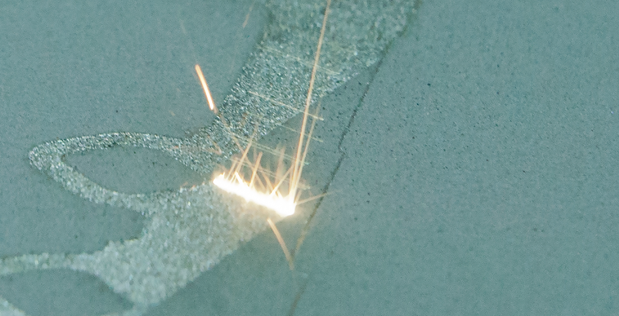
- The Rapid Low Cost Additive Manufacturing effort will use physics-based modeling to predict materials performance for direct metal laser sintering (DMLS) using a nickel-based super alloy powder. In DMLS, a laser melts the metal powder to additively build a 3D product.
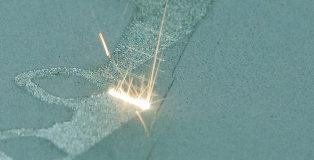 A laser beam heats a metal powder to additively build a product layer by layer.Image source: Darpa.milThe Titanium Fabrication (tiFAB) effort combines physics and data-based informatics models to figure out key parameters that affect the quality of large manufactured structures. TiFAB is a method that uses an electron beam instead of a laser to melt spool-fed titanium wire to build up a structure layer by layer.
- The Transition Reliable Unitized Structure (TRUST) effort seeks to develop data informatics approaches to quantify the composite bonding process to enable adhesives alone to join composite structures.
The Open Manufacturing program has also established two Manufacturing Demonstration facilities; one at Pennsylvania State University focused on additive manufacturing and the other at the Army Research Laboratory focused on bonded composites adoption.