
Study: Fuel Use and Traffic Flow Impacts of CAVs
S. Himmelstein | November 02, 2018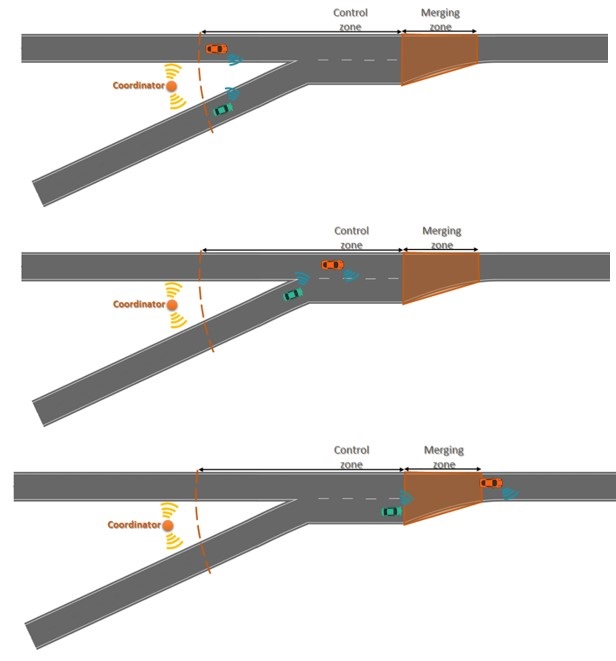 The simulation framework examined how coordinated connected and automated vehicles could improve traffic flow and reduce energy consumption during a merging on-ramp scenario while interacting with human drivers. Source: ORNL
The impact of partial market penetration of connected and automated vehicles (CAVs) on fuel consumption, travel time and traffic flow was examined with a simulation framework. The U.S. Oak Ridge National Laboratory (ORNL) exercise focused on a merging on-ramp scenario under low, medium and heavy traffic volumes.
An increased number of CAVs communicating and coordinating driving activity was found to stabilize traffic flow and, depending on the traffic volume, reduced fuel use by more than 40%. Fuel consumption benefits are realized under conditions of 100% penetration of CAVs under any traffic volume, and in mixed traffic only when the traffic volume is low. Travel time benefits are realized when all the vehicles are CAVs traveling under medium and high traffic flows, and in mixed traffic under medium and high traffic flows only if there are more than 50% CAVs on the road.
Traffic patterns become more stable as the number of CAVs on the road communicating and coordinating their operation increases.
Future research will explore the impact of CAVs in various traffic scenarios and determine whether CAVs can indirectly influence the driving performance of human-driven cars.
The study is published in IEEE Transactions on Intelligent Vehicles.




When "automation" pays the Automotive Vehicle Insurance is when they (might) have control of MY vehicle.