NJ Advances $230m Storm Defense Project
David Wagman | November 01, 2018New Jersey officials approved the alignment of a $230 million flood-control system to better protect cities impacted by Superstorm Sandy six years ago.
The flood-resistant system is intended to protect Hoboken and parts of Weehawken and Jersey City from flooding that often accompanies storms and other weather events. The project's final alignment is expected to be built along Weehawken Cove to the north, and in and around New Jersey Transit’s Hoboken Rail Yard at the southern portion of Hoboken’s Hudson River waterfront. Construction is expected to begin in early 2020 to meet a federally mandated completion date of 2023.
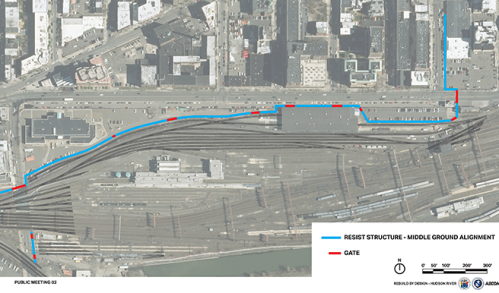 Map showing alignment of proposed flood defenses for Hoboken, New Jersey. Source: NJ DEPThe border between Hoboken and Weehawken, and the southern end of Hoboken, adjacent to Jersey City and across the Hudson River from the island of Manhattan, are low-lying areas that, during Superstorm Sandy six years ago, acted as funnels for flooding. Storm surge rushed through these two areas and joined to cause flooding from the inland side of Hoboken, effectively creating a temporary island.
Project Components
The project’s approach includes four components:
- A combination of hard infrastructure (such as bulkheads, floodwalls and seawalls) and soft landscaping features (such as berms and/or levees that could be used as parks) that act as barriers along the coast during exceptionally high tide and/or storm surge events;
- A series of policy recommendations, guidelines and urban green infrastructure to slow stormwater runoff;
- A number of green and gray infrastructure improvements, such as bioretention basins, swales and green roofs, that slow down and capture stormwater, and that are intended to complement the efforts of the City of Hoboken’s existing Green Infrastructure Strategic Plan; and
- A range of enhancements to Hoboken’s existing stormwater management system, including identifying and upgrading existing stormwater/sewer lines, outfalls and pumping stations.
 Flooded street in Hoboken, New Jersey, after Superstorm Sandy in 2012. Source: Flickr by accarrrinoThe alignment that was selected in late October is considered to be a “middle ground” between two alignments considered in the feasibility phase. It is expected to offer critical flood protections to the rail yard, while also minimizing impacts to tracks and rail service during construction.
HUD launched the Rebuild by Design competition in the summer of 2013 to develop ideas to improve physical, ecological, economic and social resilience in regions affected by Superstorm Sandy. The competition sought to promote innovation by developing flexible solutions that would increase regional resilience. The selected project was developed with the goal of reducing frequent flooding due to storm surge, high tide and heavy rainfall.
Altogether, HUD approved $930 million for Rebuild by Design projects in New Jersey, New York City and New York State. As the state’s designated HUD-grantee for Sandy recovery, the New Jersey Department of Community Affairs (DCA) will be involved in the project’s execution.
Gulf Coast Storm Defenses
In late October, Texas state officials and the U.S. Army Corps of Engineers released a draft plan detailing projects to protect the Texas Gulf Coast from storm surges.
The draft environmental impact statement includes a plan that uses a "multiple lines of defense" strategy to reduce risks to communities and infrastructure all along the Texas Gulf coast. The plan includes building surge gates to reduce coastal storm damage risks to the Houston Ship Channel, levees along Bolivar Peninsula and Galveston Island, beach and dune replenishment along the lower coast, and nine landscape-scale ecosystem restoration projects to increase resilience and reduce risks to the coast. The estimated cost is $23 to $31 billion.