Solar Charging Technology to Power Future Eco-Friendly Vehicles
Engineering360 News Desk | October 31, 2018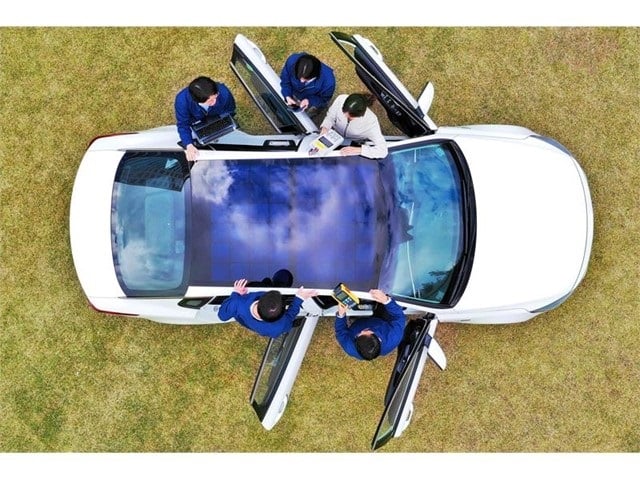 Source: Kia Motors Corporation
Kia Motors and Hyundai Motor Group plan to introduce solar roof charging technology on selected Hyundai Motor Group vehicles. Electricity-generating solar panels will be incorporated into the roof or hood of vehicles, and will support internal combustion, hybrid and battery electric vehicles with additional electrical power, increasing fuel efficiency and range.
The system will be designed to charge the batteries of eco-friendly electric and hybrid vehicles, as well as those of internal combustion engine (ICE) vehicles, helping to improve fuel efficiency.
The first-generation system under development for hybrid vehicles will feature a structure of silicon solar panels that are integrated into a standard car roof. This system is capable of charging 30% to 60% of the battery over the course of a normal day, depending on weather conditions and other environmental factors.
A second-generation technology will bring a semi-transparent solar roof system to ICE vehicles. Applying solar charging systems to ICE vehicles will help them comply with ever more stringent global environmental laws regulating carbon dioxide emissions.
The third generation of the technology will see the introduction of a lightweight solar roof for battery electric vehicles.
The Hyundai Motor Group solar charging system is composed of a solar panel, a controller and a battery. As the panel absorbs photons of light from the sun, it creates electron-hole pairs in silicon cells, enabling current to flow and generating electricity.
The controller features Maximum Power Point Tracking (MPPT), which controls voltage and current to increase the efficiency of electricity harvested by the solar panel. This power is converted and stored in the battery, or utilized to decrease load on the vehicle’s alternating current (AC) generator, thereby increasing vehicle range.
Hyundai Motor Group will launch the first generation of this technology into its vehicles after 2019 to help meet global regulations targets and improve vehicle fuel efficiency.