Ancestral Enzymes Become New Catalysts
S. Himmelstein | October 24, 2018Commercial biocatalysis depends on robust enzymes that can withstand elevated temperatures and long incubations. Past ancestral reconstruction studies have demonstrated that pre-Cambrian enzymes were often much more thermostable than currently available forms. To exploit the favorable properties of these biological 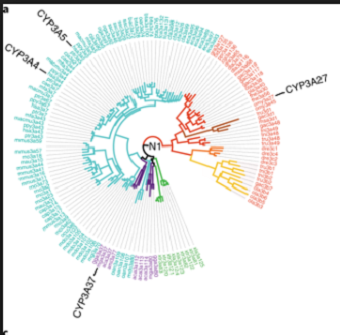 Phylogeny of the 138 sequences of extant CYP3 enzymes used to reconstruct the last vertebrate common ancestor. Source: University of Queenslandagents, researchers from the University of Queensland, Australia, recreated 450-million-year-old enzymes.
The ancestral enzymes were shown to survive temperatures of 30° C and higher temperatures and endured incubation times over 100 times longer than their extant forms. The resurrected materials could be used for faster and cheaper catalysts in processes that consume less energy and avoid toxic chemicals.
Researchers obtained gene sequence data for a particular set of ancient enzymes, reconstructed their genetic evolutionary history and determined the most likely sequence of their common ancestor that would have existed in the earliest vertebrate animals. Recreated genes were inserted into a bacterium and tested. In one case, the ancestral ketol-acid reductoisomerase showed an eight-fold higher specific activity than the cognate Escherichia coli form at 25° C, which increased 3.5-fold at 50° C.
The old-but-new enzymes might find application in the synthesis of chemicals, biofuels and drugs.