System Recycles Greywater From Handwashing
S. Himmelstein | October 22, 2018How dirty is that water you just used to wash your hands? The type of greywater produced by hygienic practices such as handwashing or bathing has a lower organic and nutrient load compared to other wastewater types. The potential to repeatedly recover and reuse this relatively clean wastewater has been advanced by environmental engineers at ETH Zurich.
After several treatment stages, greywater processed in the grid-free treatment system is odor‑free and colorless, with a bacterial count lower than that of most municipal water supplies. A fine-pored plastic 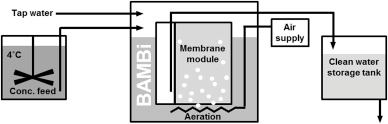 Process schematic for the biologically activated membrane bioreactor configured as a once-through treatment system. Source: ETH Zurichultrafiltration membrane retains pathogenic organisms, and microbial biofilm that develops on the membrane breaks down fecal and urinary contaminants in wastewater. However, since nutrient concentrations in handwashing water are relatively low, biological treatment performance rapidly declines. The addition of nitrogen and phosphorus to handwashing soap boosted system performance: the assimilable organic carbon removal rate increased from 85% to almost 100%.
Remaining traces of organic matter are then removed by activated carbon filtration, followed by the use of an electrolytic cell to yield chlorine from dissolved salt, which is used to disinfect water during storage.
A two-month field test was conducted in the summer of 2018 after placing a prototype handwashing system in a communal green space within the city of Zurich. The system was sometimes used by over a hundred people per day, but sufficient amounts of clean, odorless, colorless and pathogen-free water were available at all times. A second field trial is planned for a settlement in Durban, South Africa.
The system is designed primarily for use in developing regions with inadequate access to treated water supplies. Other applications, such as in passenger train toilets, are also being explored.
The study is published in Water Research.