With 3D-Printing Tech, Battery Size is No Design Problem
S. Himmelstein | October 19, 2018Designers of smartphones, laptops and other electronic devices are constrained by the dimensions of commercially available lithium-ion batteries. A product must be configured to accommodate the cylindrical or 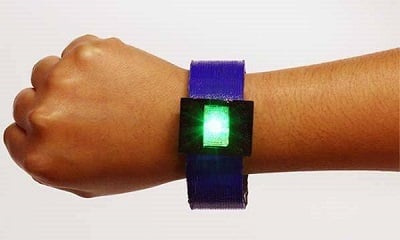 This LED bangle, including a lithium-ion battery, was made entirely by 3D printing. Source: American Chemical Societyrectangular shapes of these batteries, often at the expense of space or design optimization.
The ability to 3D print lithium-ion batteries of any shape would facilitate customizing the battery form factor for a given product design and enable its use as a structural component. However, the low ionic conductivity of polymers used for 3D printing remains a challenge for this application.
Researchers from Duke University and Texas State University devised a route around this obstacle by increasing the ionic conductivity of poly(lactic acid) (PLA). The polymer was infused with a mixture of ethyl methyl carbonate, propylene carbonate and lithium chlorate to obtain an ionic conductivity of 0.085 mS cm–1, a value comparable to that of polymer and hybrid electrolytes. Graphene or multi-walled carbon nanotubes were also blended into the anode or cathode, respectively, to increase electrical conductivity.
An LED bangle bracelet with an integrated lithium-ion battery was then fabricated with a widely available fused filament fabrication 3D printer. The bangle battery could power a green LED for about 60 seconds. While the capacity of the first-generation 3D-printed battery is about two orders of magnitude lower than that of commercial batteries, replacing the PLA-based materials with 3D-printable pastes may serve to boost battery power.