Profiling the Properties of 2D Blue Phosphorus
S. Himmelstein | October 18, 2018New research has found blue can be added to the color lineup for phosphorus. Red, violet, white and black forms of the element are now joined by a 2D blue allotrope, which could be of value in optoelectronic applications.
Blue phosphorus was successfully stabilized on a gold substrate by evaporation in previous research, but the properties and absolute identification of this form were only recently studied. Researchers from Helmholtz Zentrum Berlin (HZB) gleaned its structural details by use of diffraction, microscopy and theoretical calculations. The momentum-resolved electronic structure was profiled by angle-resolved photoemission spectroscopy, which enabled analysis of the distribution of electrons in its valence band and established the lower limit for the band gap of blue phosphorus. A valence band maximum at 0.9 eV binding energy was documented for the semiconducting 2D phosphorus.
Phosphorus atoms on the substrate were observed to adjust to the spacing of the gold atoms, serving to distort the corrugated honeycomb lattice in a regular manner which in turn affects the behavior of electrons in blue phosphorus. The top of the valence band that defines one end of the semiconducting band gap agrees with the theoretical predictions, but is somewhat shifted.
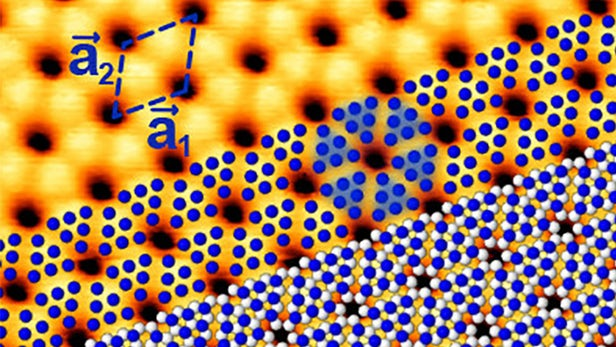 Scanning tunneling microscope image shows blue phosphorus on a gold substrate. The calculated atomic positions of the slightly elevated P atoms are shown in blue, the lower lying ones in white. Groups of six elevated P atoms appear as triangles. Credit: HZB