3D Printing Recycled Materials for Military Replacement Parts
Peter Brown | August 21, 2018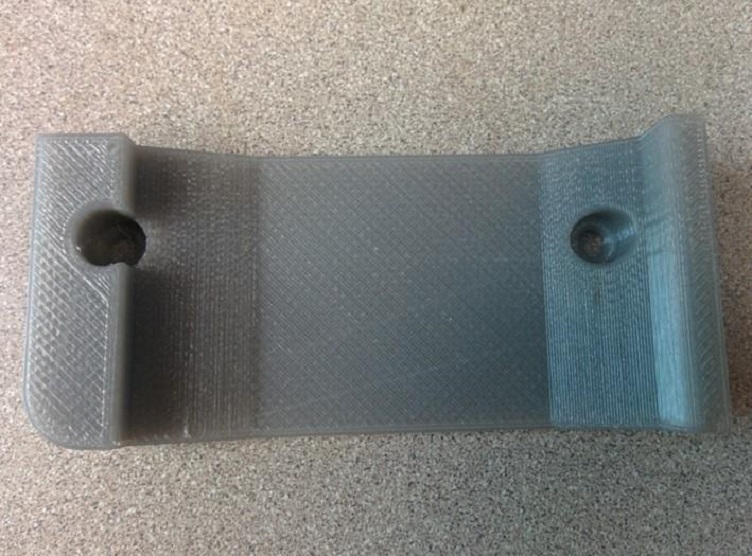 Plastic from water bottles was used to create this vehicle radio bracket using 3D printing. Source: Army Research Laboratory
Getting replacement parts to soldiers on the battlefield or in remote locations may take weeks in some circumstances. This can cause issues with operational readiness or put lives in jeopardy if the supply chain slows.
Now, researchers at the U.S. Army Research Laboratory (ARL) and the U.S. Marine Corps have tested the use of 3D printing with water bottles, cardboard and other recyclable materials found on a base or in the field in order to fabricate many of these parts within hours under combat conditions.
"Ideally, soldiers wouldn't have to wait for the next supply truck to receive vital equipment," said Nicole Zander, a chemist for ARL. "Instead, they could basically go into the cafeteria, gather discarded water bottles, milk jugs, cardboard boxes and other recyclable items, then use those materials as feedstocks for 3D printers to make tools, parts and other gadgets."
The U.S. Department of Defense has an inventory of five million items distributed through eight supply chains. But these items are rarely stockpiled at front-line locations, meaning shortages of important materials are often an issue. Many of these units have a 3D printer to produce spare parts and other equipment but need conventional feedstocks such as plastic filaments to manufacture them.
ARL explored using recycled PET plastic, found in water and soda bottles, as a starting material for 3D printers and found the material could be used as viable feedstock. The PET filaments were just as strong and flexible as commercially available filaments for 3D printing. Researchers tested recycled PET filaments to print a vehicle radio bracket which required about 10 water bottles and took two hours to complete.
Researchers found that plastic used in yogurt or cottage cheese containers or those for plastic utensils were not practical for use in 3D printing but when mixing these plastics with cardboard, wood fibers or other cellulose waste materials commonly found on military bases they could be used to create new composite filaments.
The ARL team is building a mobile recycling trailer that will allow soldiers to fabricate 3D-printing filaments from plastic waste and is exploring ways to print materials from plastic pellets instead of filaments, which could help produce larger 3D-printed parts and machinery.
"We still have a lot to learn about how to best process these materials and what kinds of additives will improve their properties," Zander said. "We're just scratching the surface of what we can ultimately do with these discarded plastics."