New Material Changes Its Structure in Response to Light
Peter Brown | July 19, 2018A new polymer material has been developed that changes its structure in response to light, converting from a rigid substance to a softer one. The material can also self-heal.
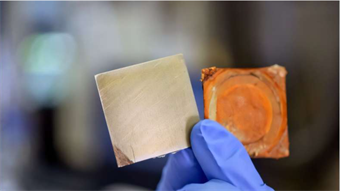
Researchers at MIT created the material consisting of polymers attached to a light-sensitive molecule that can be used to alter the bonds formed within the material. The material could be used to coat objects such as cars or satellites giving them the ability to heal after being damaged, although MIT said this is still far off in the future.
“You can switch the material states back and forth, and in each of those states, the material acts as though it were a completely different material, even though it’s made of all the same components,” said Jeremiah Johnson, an associate professor of chemistry at MIT.
MIT said it wanted to create a material that could switch between different topological states, which usually when a material is formed the topology cannot be reversed.
The material, known as polymer metal-organic cages, or polyMOCs, is based off a discovery designed a few years ago consisting of metal-containing, cage-like structures joined together by flexible polymer linkers. Researchers created the material by mixing polymers attached to groups called ligands, which bind metal atoms.
The team set out to design the new material that could switch between two different-sized cages — one with 24 atoms of palladium and 48 ligands, and one with three palladium atoms and six ligand molecules. MIT incorporated a light-sensitive molecule called DTE into the ligand. The size of the cages is determined by the angle of bonds that a nitrogen molecule on the ligand forms with palladium.
When DTE is exposed to ultraviolet light, it forms a ring in the ligand, which increases the size of the angle at which nitrogen can bond with the palladium. This makes the clusters break apart and form larger clusters.
When the material is exposed to green light, the ring is broken, the bond angle gets smaller and smaller clusters reform. The entire process takes about five hours. MIT found they could perform the switching of topology up to seven times, although a small percentage of the polymers failed to switch back causing it to fall apart.
This switching could be a boon to self-healing materials that need to become softer and more dynamic to heal before returning to a rigid state.
“Anything made from plastic or rubber, if it could be healed when it was damaged, then it wouldn’t have to be thrown away,” Johnson said. “Maybe this approach would provide materials with longer life cycles.”
Another possible application for the material is in drug delivery where it could be possible to encapsulate drugs inside the larger cages, then expose them to green light to make them open up and release their contents. It might be possible to recapture the drugs, providing a path to reversible drug delivery as well.
The next step is creating materials that can switch from a solid state to a liquid state, and using light to create patterns of soft and rigid sections within the same material.
The full research can be found in the journal Nature.