Top 100 U.S. Natural Gas Fields Named by EIA Report
Engineering360 News Desk | April 28, 2015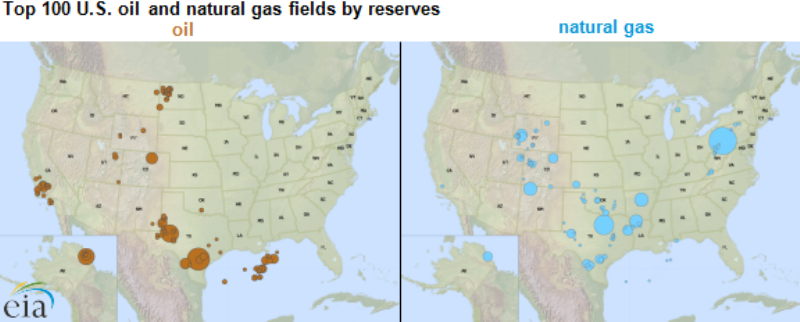 The top 100 largest oil and natural gas field locations are plotted using latitude-longitude of the approximate center of the field. Dot diameter is relative to its 2013 proved reserves. Source: U.S. EIAThe U.S. Energy Information Administration (EIA) updated its list of the top 100 oil and natural gas fields in the United States and says these fields accounted for 20.6 billion barrels of crude oil and lease condensate proved reserves, or 56% of the U.S. total in 2013. The top 100 natural gas fields accounted for 239.7 trillion cubic feet of natural gas proved reserves, 68% of the U.S. total.
Fields in the Marcellus and Eagle Ford plays appear at the top of the list, whereas in 2009 the Marcellus fields were ranked in the bottom half of the list, and Eagle Ford fields (discovered in 2008) did not appear in the top 100. Alaska's Prudhoe Bay, previously the oil field with the largest amount of reserves, fell to third, behind fields in the Eagle Ford and Permian Basin.
EIA defines a field as an area consisting of a single reservoir or multiple reservoirs grouped on, or related to, the same individual geological structural feature or stratigraphic condition. There may be two or more reservoirs in a field that are separated vertically or laterally by geologic features. However, this definition is not used by all states; consequently, areas classified as individual fields by some states may be combined in EIA's study.
According to EIA's report on U.S. oil and natural gas reserves, both crude oil and natural gas reserves increased in 2013. Oil reserves increased for the fifth consecutive year, reaching 36.5 billion barrels, and natural gas reserves offset their 2012 decline and reached a record high of 354 trillion cubic feet. Because prices affect the economics of production, price changes can have a significant effect on companies' proved reserves, EIA says. Prices that will be used for determining proved reserves for 2015 are forecast to be much lower.
EIA says that further price declines could result in reduced proved reserve additions and possibly some reduction in previously identified proved reserves because some projects may become unprofitable.