Building a Better Atomic Clock with Lutetium
S. Himmelstein | May 11, 2018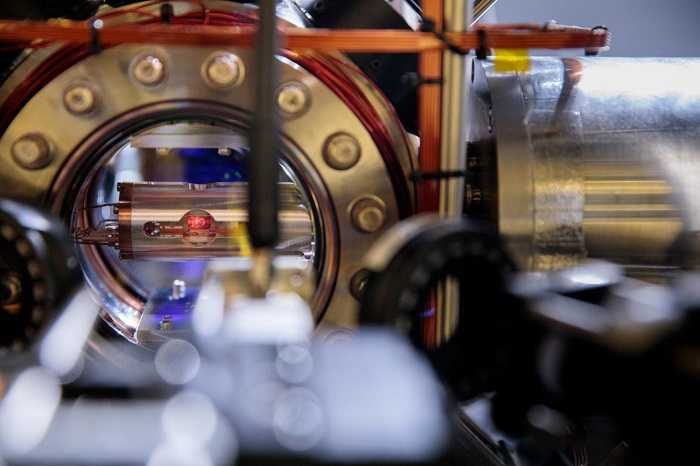 A single atom is trapped in the metal vacuum chamber with the round window. The clock's tick comes from a laser tuned to interact with this atom. Source: Centre for Quantum Technologies, National University of Singapore
The quest to build a better atomic clock points to lutetium, a rare earth element with atomic number 71, as the chronometer’s choice for more accurate timekeeping. The previously neglected element was identified by researchers from the Centre for Quantum Technologies at the National University of Singapore to have lower sensitivity to temperature than atoms used in clocks today.
Atomic clocks have set the global standard for measuring time for over half a century, but since the second was defined with reference to cesium atoms in the 1960s, there has been competition to improve the accuracy and stability of atomic clocks.
The latest generation clocks based on ytterbium, aluminum and strontium have uncertainties around one part in a billion-billion and are valuable in measuring gravity and other fundamental physics applications. The 'tick' of an atomic clock is derived from the oscillation of a light wave. The oscillation frequency is fixed by locking it to the resonant frequency of the atom.
Cesium clocks run at microwave frequency — or exactly 9,192,631,770 ticks per second. The most recent generation of atomic clocks runs at optical frequencies, which tick some ten thousand times faster. Counting time in smaller increments allows for more precise measurement.
Lutetium will also run at optical frequencies, but unlike other elements, its performance remains stable over time. A contributor to clock inaccuracy is sensitivity to the temperature of the environment surrounding the atom. A six-month effort to measure the strength of this 'blackbody radiation shift' for clock transitions in lutetium revealed a result for the blackbody radiation shift for one energy level transition that is closer to zero than for any established optical atomic clock.
The researchers are developing clocks with single ions and ultimately would like to make clocks based on lattices or networks of many ions. They begin with lutetium in bulk form — as a silvery-white metal foil — before boiling a few atoms off into their apparatus.
The research is published in Nature Communications.