Driving Toward Low-carbon, High-speed Vehicles
Mike Farish | October 02, 2014Over the next few months initial production is set to get under way as part of an unusual manufacturing venture in the UK that promises to benefit the automotive industry in its pursuit of low carbon-emission vehicles.
 The MSYS transmission. Source: Drive System Design
The venture was launched in 2013 with backers that included vehicle maker Jaguar Land Rover and industrial concern Tata Steel. It aims to identify small UK operations that are developing products with the potential to help worldwide automotive manufacturing achieve what is arguably its major global challenge in the early 21st century: implementing technologies that will enable production of genuinely low-carbon emission vehicles. The venture provide both the engineering input required to bring those products into production and also carry out initial low volume manufacturing (in the range of a couple of thousand units a year) to provide the necessary kick-start.
The underlying business model is that income for both the technology developers and the Proving Factory itself will be generated by early sales and from licensing income once production is taken over by a third party. At present the initiative, which aims to employ as many as 250 people by the end of 2015, is outfitting a component manufacturing facility in Rotherham in northern England. A final assembly plant is to follow in Coventry in the Midlands, the traditional heart of the UK automotive industry. With time, products from as many as 20 companies may be produced in this way.
Three companies that have recently signed agreements to become production partners help to illustrate the technologies that are being backed by the initiative.
One company is Sheffield-based Magnomatics, described by its Business Development Manager David Latimer as a developer of products based on magnetic gear technology. In general terms, he says, the idea of magnetic gears has been around for some time, even though practical applications are relatively recent. In the case of Magnomatics, which was set up in 2006, its first products went into service in the oil and gas industry within the last few years.
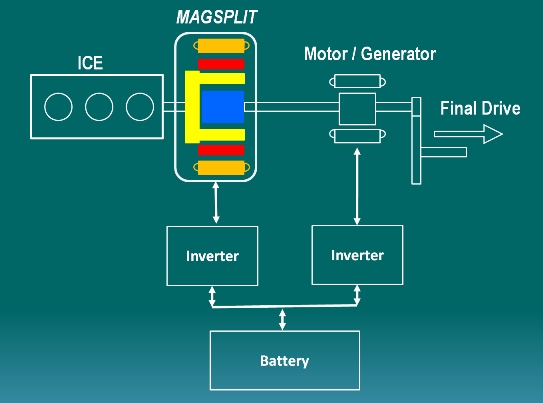 'The MAGSPLIT device is intended for use in powers-plit hybrid vehicles'. Source: Magnomatics
Latimer says a conventional magnetic gear is analogous to a mechanical planetary gear and consists of two rings of permanent magnets with a ring of intervening steel pole pieces that act as flux paths between the magnetic rings. The air gaps between pole pieces and magnetic rings act as flux barriers. In operation, one of these elements is held static while the other two rotate with a fixed gear ratio. By ensuring that the outer magnetic ring has more poles than the inner one, this approach ensures that, in common with a mechanical counterpart, the inner magnetic ring is always the high-speed rotor.
The MAGSPLIT pioneers a new approach to the established configuration by introducing a wound stator around the exterior of the whole device and by providing the outer magnetic ring with fewer poles than the inner one. This means that not only are all three rings free to rotate, but the outer ring becomes the high-speed "control" rotor so that the conventional approach is effectively turned inside out.
Then, by controlling the rotational speed of this outer ring of magnets it is possible to change the gear ratio between the inner magnetic rotor and the steel pole pieces. The ratio can be continuously adjusted and even can be set such that the output shaft is stationary or reverses. Latimer describes this approach as “ideal” for a hybrid vehicle.
Latimer says that simulation work has already indicated that the MAGSPLIT could provide 3-5% greater fuel economy than a conventional electronically-controlled CVT, depending on the drive cycle.
 'The MAGSPLIT device promises 3-5% better fuel economy than conventional counterparts. Source: Magtronics
Another technology that may gain traction via the Proving Factory is Drive System Design (DSD) of Leamington Spa in the UK Midlands. Technical Director Alex Tylee-Birdsall says that the company has set up a new operation called Evolute Drives to bring to the Proving Factory a three-speed electric vehicle transmission known as the MSYS. He says, however, that the technology still could be as much as three years from production.
The device is a “power-shifting transmission” that can provide continuous torque to the wheels with little if any interruption during gear changes. This attribute is particularly valuable in vehicles where energy efficiency is a paramount concern and also contributes to the quality of the driving experience. Unlike existing counterparts, it does not require continuous power to drive a pump to hold it in gear during operation. This innovation could make a big contribution to the vehicle's overall energy efficiency.
The device achieves this objective by deploying established technologies rather than by inventing some new means of doing so. Its innovation derives from its configuration. As Tylee-Birdsall says, “We wanted something that could latch into place just like a manual transmission, so we haven’t invented a new type of shifting device.”
What DSD devised was a mechanism that uses a conventional hydraulic "dog clutch" as the final link from the gearbox to the powertrain. When that is accomplished the system is “in gear,” Tylee-Birdsall says. More important from the standpoint of an electric vehicle, only occasional charging of an accumulator is necessary to enable it to keep in gear. The key point is that “you only have to put power through it again when you want to shift gear” Tylee-Birdsall says.
In theory the device could be also used in a car with an internal combustion engine. In practice, however, the comparative ease of torque and speed control inherent in an electric motor means that it lends itself best to use in electric vehicles.
But there is nothing theoretical about the device itself. It already has been shown to work in practice on a demonstration vehicle. “The first clutch-to-clutch shifting took place in June this year,” Tylee-Birdsall says.
Nevertheless, the device remains a prototype and further work will aim to implement several “production level” changes suggested by the Proving Factory as well as “development level” changes to enhance the device's performance. The latter includes uprating its torque capability from 220Nm to 300Nm.
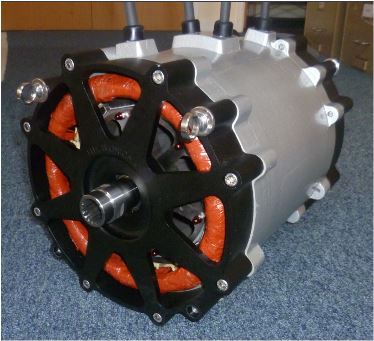 'The GEN F-50 will use second-generation ferrite magnets. Source: Electronica
The first is that it will use second-generation ferrite magnets that are much more powerful than previous comparable materials although not quite as powerful as rare earth counterparts. The second is that it will have an "integrated cast cooling jacket,” whose design is patent pending.
Shirazee says that the cost of rare earth materials has “gone through the roof” in recent years and is now prohibitive. As such, Electronica has worked with ferrite magnet material suppliers to develop an appropriate formulation for magnets to be used in its product. He says that second-generation materials, which are “at least twice as powerful” as first-generation equivalents, have only been available for the last 18 months and that Electronica’s use of them will be among the first in the motor generator field.
On the second count, Shirazee says that previous practice has involved “shrink-fitting” a machined cooling jacket on to the stator of a generator. Electronica intends instead to cast the jacket directly on to the stator. Not only will this reduce the relevant manufacturing costs “from thousands of pounds to hundreds,” but it also will improve its thermal efficiency.
In use the generator, called the GEN F-50, would operate in a conventional manner in a hybrid vehicle. Shirazee says that it would be driven by a small diesel engine running at a constant speed (and therefore most efficiently) as it supplies electricity either to batteries or to the vehicle’s power electronics, as required. It breaks new ground through its reduced overall cost. Shirazee says that cost is the “number one concern” of electric vehicle developers at present. He estimates that the Electronica product could feasibly cost as little as one third of current counterparts.
Shirazee says that the product has attracted interest from a potential major customer. Even so, Electronica's immediate priority is to ready the product for manufacture at the Proving Factory. He says it is feasible that initial production in low but commercially viable volumes could be achieved some time in 2015.