Watch: Laying Waste to Oil Spills
S. Himmelstein | April 20, 2018This could be the ultimate environmental irony: using waste products from the petroleum and refining industries to remediate oil spills. An international team of researchers has demonstrated that a type of polymer made from waste cooking oil and sulfur, a by-product of the petroleum sector, has the ability to clean up crude oil and diesel spills.
The highly buoyant polymer functions as a sponge to absorb spilled materials from sea water. It can also be squeezed to recover the oil and then reused.
Oil spills are a major global issue, with the International Tanker Owners Pollution Federation reporting about 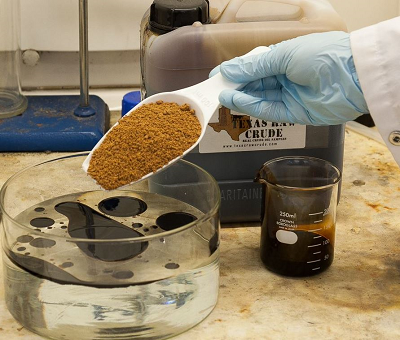 Adding the polysulfide to a crude oil sample. Source: Flinders University7,000 tons of crude oil spilling from tankers into oceans in 2017 alone. The effects of recent large-scale spillage catastrophes are cited as a motivation for the research — in particular, the explosion on the Deepwater Horizon offshore drilling rig in April 2010 and subsequent release of approximately 4.9 million barrels of crude oil into the Gulf of Mexico.
Numerous smaller spills of diesel fuel and other petroleum products affect developing countries in Africa, Asia and South America. The new material derived from cheap and sustainable products will help respond to these developing countries where smaller, localized spills threaten groundwater, drinking water and important food staples such as fish.
Sulfur and cooking oils are hydrophobic, so the polymer has an affinity for hydrocarbons such as crude oil and diesel fuel, and can rapidly remove them from seawater. Laboratory tests showed that absorption of the pollutant happens within a minute of the solution being sprinkled onto oil covering the surface of water.
Researchers from Flinders University, Australia; University of Queensland, Australia; Cambridge University, UK; IMM, Portugal and Instituto de Medicina Molecular, Portugal, participated in this study, which is published in Advanced Sustainable Systems.