Novelty Robot Concierge Expected to Improve Along with AI
Marie Donlon | April 03, 2018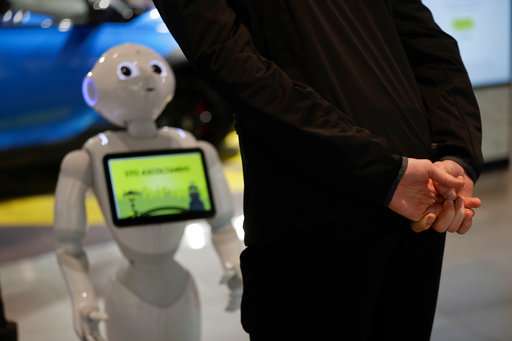 A guest asks robot Robby Pepper for information a hotel in Peschiera del Garda, northern Italy. Robby Pepper, billed as Italy's first robot concierge, has been programmed to answer simple guest questions in Italian, English and German. The humanoid, speaking robot will be deployed all season to help relieve the desk staff of simple, repetitive questions. Source: AP Photo/Luca BrunoConsidered Italy’s first robot concierge, the humanoid, which can answer questions in English, German and Italian, will now be used year-round at a hotel in Lake Garda where it will help alleviate desk traffic by offering answers to simple, repetitive questions.
Called Robby Pepper, the robot concierge was created by Japan’s Softbank Robotics and is capable of answering questions such as where the spas are located, where the restaurants are located and their hours of operation.
Programmed by the Italian digital services company Jampaa, Robby is expected to learn even more during the summer tourist season where the robot will likely encounter unanticipated questions and improve vocabulary and knowledge.
Joining a growing number of robots being used in industries such as tourism, experts agree that humanoid robots are mostly used as a novelty to draw customers in, explaining that they will be scaled up only when improved artificial intelligence is available.
"Beyond the techy novelty to engage customers, the current use of robots for customer services is completely impractical, very simply because artificial intelligence digital agents are way too stupid to be practical beyond what the time is and what the weather is," said Richard Windsor, a technology analyst based in London.
As such, Windsor believes that the robots will eventually lose their current appeal but will reemerge once the technology has improved.
"In order to make these things better, you need to gather data, so have you have to be out there," he said.