Edges and Corners Increase Catalytic Converter Efficiency
S. Himmelstein | April 01, 2018Researchers from Germany and Sweden have demonstrated a pathway to improving the exhaust gas cleaning efficiency of catalytic converters: give them an edge. A large number of edges increases the efficiency of catalytic reactions, as the different facets of the nanoparticles are often covered by growing islands of a nano oxide, finally rendering these facets inactive. At the edges, the oxide islands cannot connect, leaving active sites for the catalytic reaction and an efficient oxygen supply.
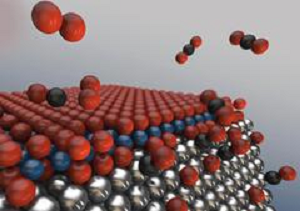 With increasing oxygen (red) concentration, an oxide sandwich forms on the surface of metallic nanoparticles, inhibiting the desired reaction of carbon monoxide to carbon dioxide. At the edges, however, the oxide sandwich breaks up, leaving free active sites for catalysis. The more edges the nanoparticles possess, the more efficient the catalytic converter. Source: DESY, Lucid BerlinPlatinum-rhodium nanoparticles were grown on a substrate in a way so that all the particles were aligned in the same direction and had the same shape of truncated octahedrons. The catalytic properties of this sample were then examined under the typical working conditions of an automotive catalytic converter, with different gaseous compositions in a reaction chamber. Efficiency was gauged by mass spectrometry to reveal the proportions of certain types of molecules in the exhaust emissions, including the relative concentrations of carbon monoxide, oxygen and carbon dioxide. The parallel alignment of the nanoparticles enabled determination of those surfaces on which the reaction went particularly well.
The reactivity of the nanoparticles was observed to increase sharply at a certain oxygen concentration — when just enough oxygen is available to oxidize each carbon monoxide molecule and turn it into carbon dioxide. Beyond that concentration, the reactivity gradually declines because a thick oxide layer grows on the particle surfaces and impedes the reaction.
The X-ray analysis showed that once a certain oxygen concentration is exceeded, the different crystal faces of the nanoparticles become coated with an oxygen-rhodium-oxygen sandwich, until eventually the surface of the metal is completely covered by this nano oxide layer. However, the oxygen is unable to form a closed film along the edges between the faces of the nanoparticles, which means that the reactivity along the edges is higher.
Scientists from Deutsches Elektronen-Synchrotron DESY and Universität Hamburg, both in Hamburg, Germany, and Sweden’s Lund University participated in this research, which is published in the journal Physical Review Letters.