A Breakthrough for Metallic Glass
Tony Pallone | March 27, 2018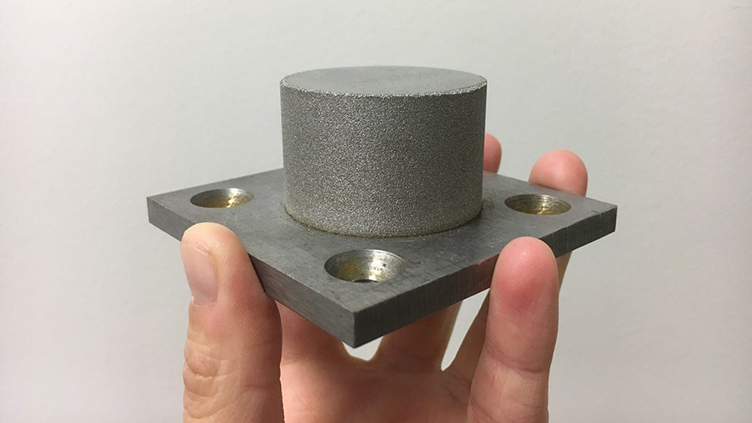 A metallic glass (amorphous iron alloy) cylinder made via 3D printing. Source: Zaynab Mahbooba.
The ability to 3D print metal alloys that lack crystalline structure, also known as amorphous metal or metallic glass, could open the door to a variety of applications: electric motors with higher efficiency, materials with higher strength and better wear-resistance, structures with lighter weight. It's something researchers have been working on for more than a decade.
Because making metallic glass requires rapid cooling in order to keep a crystalline structure from forming, it has been possible thus far only to cast metallic glasses into small thicknesses. But researchers at North Carolina State University have demonstrated the ability to transcend that limitation, also known as an alloy's "critical casting thickness," through an innovative additive manufacturing technique.
The technique works by applying a laser to a layer of metal powder, melting it into a thin solid layer just 20 microns thick. The printer's build platform then descends 20 microns, spreads more powder onto the surface and repeats. The alloy is thus formed little by little, cooling quickly and retaining its amorphous qualities. The end result is an object made of solid metallic glass.
"The idea of using additive manufacturing, or 3-D printing, to produce metallic glass on scales larger than the critical casting thickness has been around for more than a decade," says Zaynab Mahbooba, first author of a paper on the work and a Ph.D. student in NC State's materials science and engineering department. "But this is the first published work demonstrating that we can actually do it. We were able to produce an amorphous iron alloy on a scale 15 times larger than its critical casting thickness."
"This is a proof-of-concept demonstrating that we can do this," adds Ola Harrysson, a corresponding author of the research who serves as a professor of industrial systems and engineering at NC State. "And there is no reason this technique could not be used to produce any amorphous alloy… because we're talking about additive manufacturing, we can produce these metallic glasses in a variety of complex geometries -- which may also contribute to their usefulness in various applications."
The research is published in the journal Applied Materials Today.