Brains and Brawn: A Smart Car with Potent Engineering
Kevin J. Harrigan | April 09, 2015In many ways, the microcar saved the fate of the personal automobile in Europe. Automotive resources waned after World War II in the face of massive reconstruction, so manufacturers that focused on affordable autos elected to produce bubble cars (microcars).
These were ultra-light three-and four-wheeled vehicles, outfitted with engines of 700cc or less that were legally qualified as motorcycles. To say microcars were rudimentary is an understatement; at least one model replaced the reverse gear with an external handle so the operator could physically pull the car backwards.
The microcar never made it the United States, meaning the smallest production auto ever to be available in the U.S. is the Smart Fortwo (technically a subcompact), where the dominant narrative is the vehicle's underwhelming size. In a nation of highways built for road trips, the Fortwo is disparaged for its small engine and cabin, short range and feeble performance.
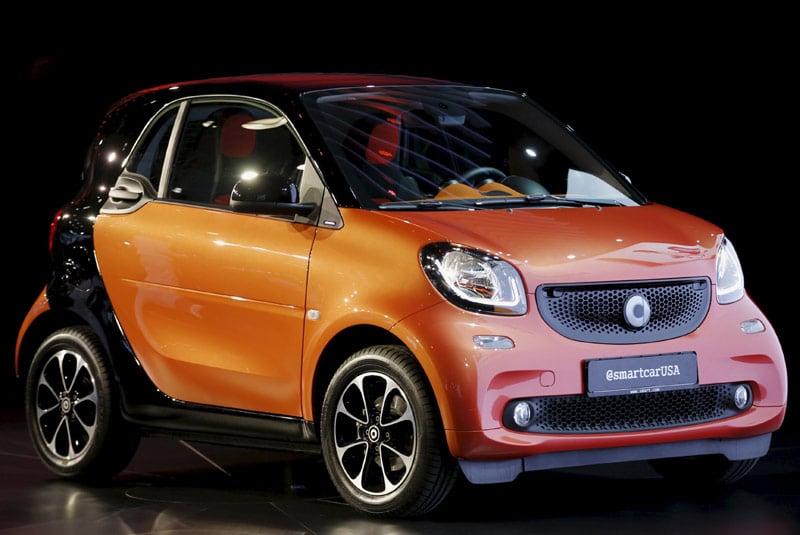 The 2016 Smart Fortwo Car introduced at the 2015 New York Auto Show. Source: Autoshowny.comHowever, don't mistake this small-time auto for small-time engineering. Smart (and its parent company Daimler) is confident that it can find a market for the Fortwo in the United States, which is why at the New York International Auto Show in April the company introduced the third-generation Fortwo to American audiences. Dealers will be displaying them in showrooms by the end of the year, likely with a price tag that resembles the car's stature.
Safety
A number of challenges arise when designing a full-function automobile that has a wheelbase of 74 inches and curb weight of 1,900 pounds( lb), and safety is paramount in the Fortwo's design. Basic physics promises that the vehicle with more mass will experience less force during a collision, leaving the Fortwo at a disadvantage. As such, Smart has always placed the engine in the rear of the vehicle to maximize the Fortwo's crumple zone.
All 2016 Fortwos will include Smart's proprietary Tridion safety cell, a rigid occupant structure composed of hot-formed steel and lightweight aluminum. Mercedes pitted the 2016 TwoFour against its own C- and S-Class models in crash tests and discovered that the Tridion shell is so strong it activated the crumple zones of the other car. The next-gen Fortwo weighs 100 lb more and has a 4-inch wider stance than previous Fortwos, and will also contain six or eight airbags for cabrio or hardtop models, respectively.
Crosswind Assist
Active driving systems will also improve safety. For the first time, the Fortwo will be outfitted with crosswind assist. The Fortwo is especially prone to lane drifting due to strong winds or the air wakes of other vehicles. An integral monitoring system identifies when strong crosswinds are present and helps maintain vehicle stability. Also available will be lane assist, parking assist and collision warning systems.
Though the Fortwo is not meant to be a performance vehicle, the vehicle's handling (which TopGear once called "craptastic") is also a safety issue. The Fortwo is known for its high degree of understeer, but engineers mitigated this by retuning the 2016 Fortwo's MacPherson struts located at the front axle and the DeDion rear-axle design. Additional suspension options, such as a sports package with firmer springs, will provide better vehicle response. The 2016 model also boasts a 22.8-foot turning radius. Finally, an improved electronic stability program (ESP) helps control wayward handling.
Turbocharged Engine
Of course, not changing anything about the Fortwo's performance would be an opportunity wasted. Daimler engineers consulted with Ford on the latter's EcoBoost engine line and leveraged this know-how into a gas-fed, turbocharged, 3-cylinder, 0.9-liter engine that produces 89 bhp, 100 lb.-ft. of torque and a 96 mph top speed. Transmissions offered will be a 5-speed manual and an automatic dual clutch. While gas economy hasn't been mentioned, it's expected to be in the 45 mpg neighborhood.
Modern amenities are also on their way to the Fortwo. While non-turbo and diesel variants will be manufactured, none will be sold in North America. Instead, an all-electric Fortwo, with a 0-60 mph time of 4.8 seconds and 60-mile driving range, is expected to make the transatlantic voyage (via ship, of course) in 2016. The Fortwo will also get sorely needed infotainment upgrades, as well as LEDs and universal smartphone support.
None of these redesigns or features will ensure the 2016 Fortwo's stateside success. By almost all measures it seems like a niche car: useful for getting around cities or campuses, but impractical beyond the suburbs. Smart is doing its best to erase the preconceptions about a stale auto, and in doing so could jump-start a new market segment in the United States.