Bone Repair Triggered by 'Flexoelectric' Effect
Tony Pallone | January 19, 2018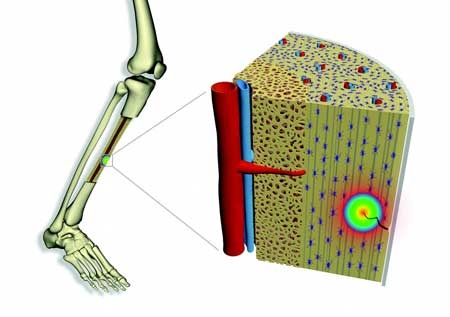 Flexoelectricity produced by bending is believed to trigger the healing of everyday microfractures. Image credit: UAB.This just in, from researchers at the Universitat Autònoma de Barcelona (UAB): Bone is flexoelectric.
The term refers to the ability to produce electricity by bending, and it would appear that this plays a role in the regeneration of bone tissue in and around microfractures – which are incurred by bones on a daily basis.
The information is not entirely new – electricity generated under pressure to stimulate self-repair and remodeling was first reported in the late 1950s, and was attributed to collagen, bone’s organic component. Collagen is known to exhibit piezoelectricity, the ability to generate electricity as a result of mechanical stress or vibration. Studies have since observed, however, markers of bone repair in the absence of collagen. The new discovery of a flexoelectric effect is being attributed to bone’s mineral component.
The response is extremely localized; with microfractures, it is an atomically small site such as the tip of a crack. The flexoelectric field generated around these tiny areas concentrates the maximum strain a material is able to withstand before full rupture. The effect is large enough to be sensed by the cells responsible for bone repair. It would also appear that the electric field distribution serves as a moving beacon for the body’s repair efforts, pinpointing the center of the damage as the crack is healed.
The researchers have been able to calculate the exact magnitude of this electric field by studying strain gradients in hydroxyapatite, or pure bone mineral, and bones themselves. The quantitative similarity between the two materials directly implicates the role of flexoelectricity in bone repair.
The study, published in the journal Advanced Materials, has potential implications for the prosthetics industry and the development of biomimetic self-healing materials. New materials that reproduce or amplify the flexoelectric effect could be used, for instance, to guide tissue regeneration and lead to more successful assimilation of implants.