
Boeing Reveals Hypersonic Demonstrator Aircraft
Eric Olson | January 17, 2018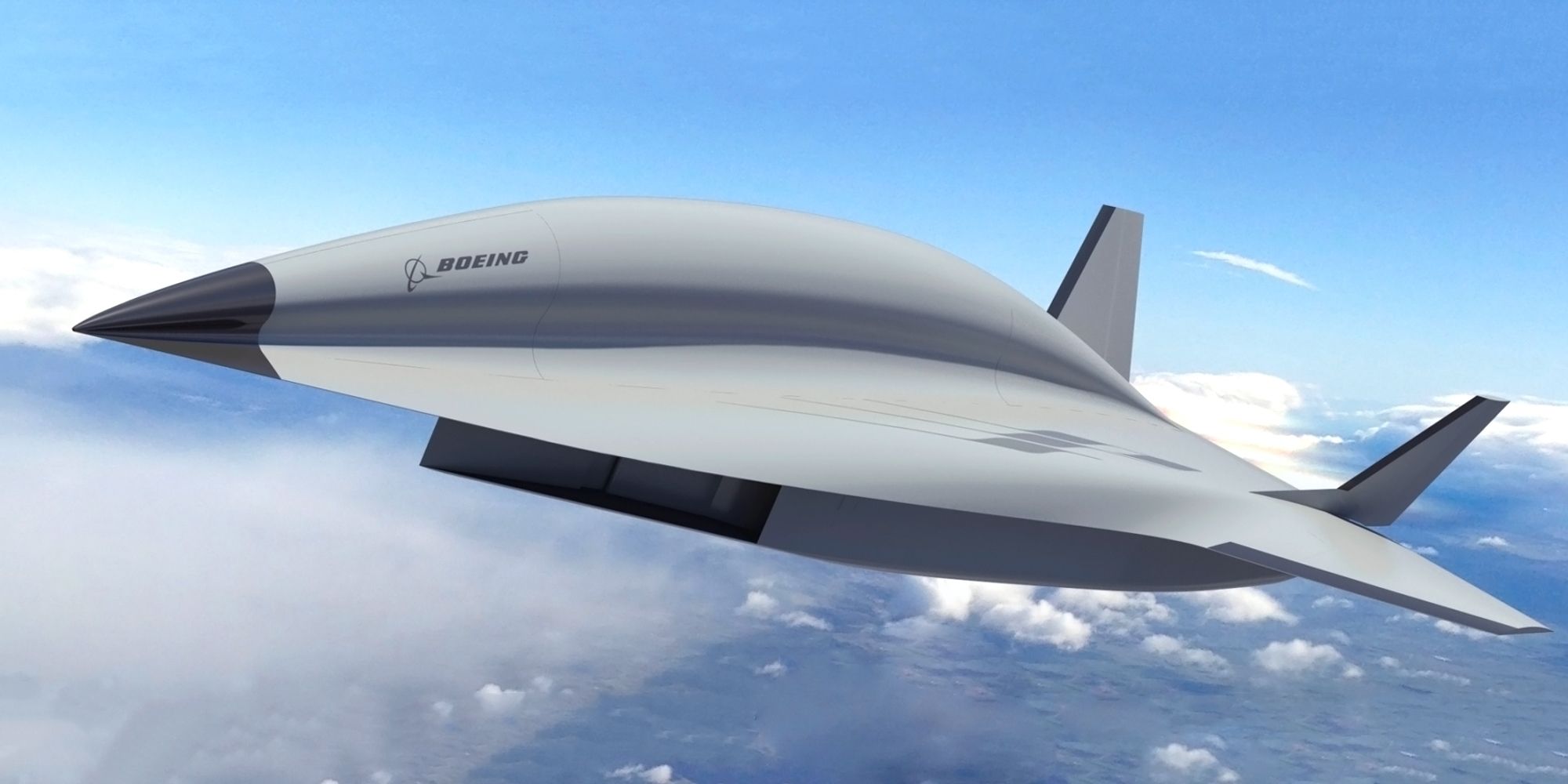 Boeing’s hypersonic demonstrator could serve as the foundation for a future aircraft with strike and reconnaissance capabilities. Source: BoeingBoeing has unveiled its concept for a hypersonic demonstrator aircraft that could lead to a successor to the SR-71 Blackbird spy plane. Designed to reach top speeds above Mach 5, the demonstrator would nearly double the SR-71’s top speed of Mach 3.3 (3,540 km/hr or 2,200 mph).
A model of the vehicle was on display last week in Florida at the SciTech forum hosted by the American Institute of Aeronautics and Astronautics. The aircraft features a twin-tail, delta wing configuration with a sharply swept forebody. An inlet split by a protruding septum below the fuselage scoops air to feed the dual engines.
Boeing has some past hypersonic experience it is building on with the new aircraft. The company contributed to both the X-43 and X-51 Waverider test vehicles, both record setting hypersonic demonstrators. Flying in November 2004, the X-43A reached a new high top speed of Mach 9.6 (10,617 km/hr or 6,598 mph). The X-51A set a record in May 2013 for sustained air-breathing hypersonic flight, flying for three and a half minutes at Mach 5.1 (5,400 km/hr or 3,400 mph).
But the X-51 had help reaching hypersonic speeds. It was released from a B-52 aircraft at an altitude of 50,000 ft. (15,000 m) and accelerated by a rocket to Mach 4.8 before the scramjet took over. And it didn’t need to land: it crashed into the ocean once it ran out of fuel.
Boeing’s hypersonic vehicle will need to take off and land under its own power, a feat that involves overcoming some formidable engineering challenges.
“It’s a really hard problem to develop an aircraft that takes off and accelerates through Mach 1 all the way to Mach 5 and beyond,” said Kevin Bowcutt, Boeing’s chief scientist for hypersonics, speaking to Aerospace Daily & Defense Report. “The specific impulse of an air breathing engine goes down with increasing velocity, so you have to make the engine bigger to get to Mach 5. But doing that means a bigger inlet and a bigger nozzle, and trying to get that through Mach 1 is harder.”
One option to solve this problem is known as the turbine-based combined cycle (TBCC) propulsion system, integrating a standard turbine engine with dual-mode ramjet/scramjets (DMRJ). In the TBCC system, the turbine engine provides thrust from takeoff to around Mach 3, at which point the ramjet accelerates the vehicle to hypersonic speeds, switching to scramjet mode at Mach 5.
Funding for initial work on Boeing’s hypersonic demonstrator vehicle came from the company’s own coffers. But now the concept has earned government backing through DARPA’s Advanced Full Range Engine (AFRE) program which awarded $21.4 million in September 2017 to Orbital ATK, Boeing’s partner working on the TBCC engine. The U.S. Air Force Research Laboratory is also running a TBCC flight demonstration concept study that Boeing and Orbital ATK joined in 2016.
Lockheed Martin revealed work on its own successor to the SR-71 in 2013. The SR-72 will be an optionally piloted hypersonic aircraft with long-range strike and reconnaissance capabilities. Lockheed is collaborating with Aerojet Rocketdyne on development of the TBCC engine for the aircraft. Flight tests of a single-engine, scaled SR-72 demonstrator could begin as early as 2020.



This is going to be really, really complicated by the time she takes off and lands under her own power, but what a bird this will be.
They will have to invent a whole new bird name for her. Twice the speed of the Blackbird (SR-71), what could we come up with to name this graceful, swift bird...
Peregrine Falcon is the fastest biological bird.
This lady of the air may be too fast for a name.
In reply to #1
PF Flyer comes to mind