3D Printing the Future of Thermal Management
Shawn Martin | December 18, 2017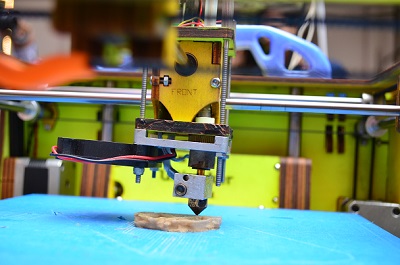 Source: Subhashish Panigrahi / CC BY-SA 3.0
Thermal products like cold plates, heat sinks and other metallic objects were inherently difficult to produce using traditional additive manufacturing (AM) methods. Now, after a tremendous growth curve in the field of powder bed fusion technologies, mass production of metallic parts is not only possible, it also provides manufacturers with the added benefits of a shorter development cycle and lower parts volume in finished assemblies.
How Do They Make it Possible?
Additive manufacturing (AM) is a suite of manufacturing processes that create objects by material deposition. Thin layers are deposited one layer at a time until a desired shape or object is formed.
Powder bed fusion techniques accomplish this task through the use of high-powered lasers or electron beams. They scan across a thin layer of powders attempting to confine the melt pool and prevent material redistribution during non-equilibrium phase transitions.
Traditionally, metallic objects were inherently difficult to use in these processes. Material defects including residual porosity, inconsistencies and abnormalities were more prevalent due to the increased tendency for scattering and absorption of incident radiation and free electrons coupled with the increased process temperature required for fusion of metallic elements.
The resulting enlarged heat affected zone and melt pool is mobilized by the associated surface tension and recoil pressures. Material flows away from the weld pool, allowing for inherent porosity, increased surface roughness and the formation of abnormalities, which are then amplified by the successive layers being deposited.
The enlarged heat affected zone is now being controlled through advanced AM processes, including selective electron beam melting (SEBM) and laser powder bed fusion (LPBF) techniques.
LPBF has evolved by incorporating finely tuned fiber lasers. The enhanced capabilities of modern fiber lasers allows for higher repetition rates, shorter pulse widths, higher photon densities and smaller focal points. Lasers are tuned to address melt pool dynamics by balancing surface tension and recoil pressures present in the laser-heated zone.
SEBM has evolved as well. Superior electromagnetic lenses and advanced control of the electron beam allow for finer focal points and inertia-free movement of the electron beam. Point-to-point heating leads to more control over the heat affected area.
The evolution of LPBF and SEBM processes allows engineers to produce thermal management solutions, including electronics packaging, heat sinks and cold plates with fewer defects and better surface characteristics.
Added Benefits
Manufacturers like Northrop Grumman and Raytheon are continually perfecting the LPBF and SEBM processes. From aluminum powder bed fusion technology to advanced titanium metal powder bed fusion techniques, they are able to produce parts that exhibit superior performance characteristics.
Their ability to eliminate inherent porosity and achieve superior surface quality is not the only motive for implementing AM techniques for thermal management solutions. There are also several added benefits presented to the manufacturing process. Manufacturers are able to greatly decrease cycle time and create complex geometries that were not possible when using conventional manufacturing methods.
Complex components are produced in under a week where traditional methods required months. Users are able to combine multiple parts alleviating the needs for vacuum brazed joints while benefiting from increased design flexibility.
Most CAD-designed topologies can be produced by a single part. Traditionally, this was not possible as fine details could only be produced on the exterior of a finished part. Through AM there is inherent control over each layer in the deposition processes and intricate details can be layered on top of each other.
Conclusion
Reduced cycle times allow for rapid design iterations, improving design flexibility during the product development phase. AM was once confined to this market, but now with part count reductions, improved material characteristics and the capability to produce finer details, advanced AM technologies like LPBF and SEBM are being introduced as a preferred technology for mass production of thermal management solutions.
Resources: