Stainless Steel Nanotexturing Wipes Out Surface Bacteria
S. Himmelstein | December 13, 2017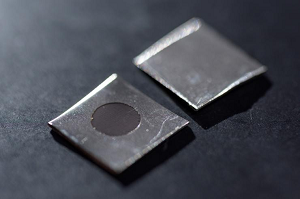 Close-up image shows an untreated stainless steel sample (left), and a sample electrochemically treated to create a nanotextured surface. Source: Rob Felt, Georgia Tech
When does stainless steel kill bacteria? When the common alloy is nanotextured by electrochemical etching.
Stainless steel 316L, widely used in medical devices and food processing equipment, is prone to bacterial adhesion, which can cause serious infections. The nanotexturing process tested by Georgia Institute of Technology researchers was shown to inactivate bacteria without adverse impacts to mammalian cells. The evolution of tiny spikes and other nano-protrusions on the surface is believed to puncture bacterial membranes.
In addition to inhibiting adhesion of both Gram-negative Escherichia coli and Gram-positive Staphylococcus aureus, the treatment appears to improve corrosion resistance. Compatibility with mammalian cells, as demonstrated with mouse cells, is crucial for medical applications since cells must adhere to implants. The surface modification should also prevent bacteria from adhering to food processing equipment, enhancing existing sterilization techniques.
“This surface treatment has potentially broad-ranging implications because stainless steel is so widely used and so many of the applications could benefit,” said Julie Champion, an associate professor in Georgia Tech’s School of Chemical and Biomolecular Engineering. “A lot of the antimicrobial approaches currently being used add some sort of surface film, which can wear off. Because we are actually modifying the steel itself, that should be a permanent change to the material.”
Texturing increased the surface segregation of chromium and molybdenum and improves corrosion resistance, which is what differentiates stainless from conventional steel. Researchers observed protrusions 20 to 25 nanometers above the surface.
The research is published in the journal ACS Biomaterials Science & Engineering.