MIT CSAIL: Less Tailgating Equals Fewer Traffic Jams
Amy J. Born | December 14, 2017 Berthold Horn and Liang Wang. Source: MIT CSAILResearchers from MIT’s Computer Science and Artificial Intelligence Laboratory (CSAIL) recently showed that we’d have fewer traffic jams if we made one small change to how we drive: no more tailgating.
In a new journal article, the team argues that if drivers all kept an equal distance between the cars in front of and behind, we would all get where we’re going almost twice as quickly. MIT professor Berthold Horn describes this approach as “bilateral control.”
“We humans tend to view the world in terms of what’s ahead of us, both literally and conceptually, so it might seem counter-intuitive to look backwards,” says Horn, who co-authored the article with postdoctoral associate Liang Wang. “But driving like this could have a dramatic effect in reducing travel time and fuel consumption without having to build more roads or make other changes to infrastructure.”
Horn suggests that car companies update their adaptive cruise-control systems and add sensors to both their front and rear bumpers. (Most of today’s systems only have front sensors.)
Traffic would get noticeably better even if just a small percentage of all cars were outfitted with such systems, Horn surmises. In future work funded in part by Toyota, he plans to do simulations to test whether this method is not just faster for drivers, but also safer.
The team’s work has been inspired in part by how flocks of starling birds move in tandem.
“Birds have been doing this for centuries,” says Horn. “To program this behavior, you’d want to look at the birds all around you and not just the ones in front of you.”
According to the CSAIL team, for decades there have been hundreds of academic papers looking at the problem of traffic flow, but very few about how to actually solve it.
Horn first proposed the concept of “bilateral control” in 2013 at the level of a single car and the cars directly surrounding it. With the new paper, he has taken a more macro-level view, looking at the density of entire highways and how miles of traffic patterns can be affected by individual cars changing speeds (which his team refers to as “perturbations”).
“Our work shows that, if drivers all keep an equal distance between the cars on either side of them, such ‘perturbations’ would disappear as they travel down a line of traffic, rather than amplify to create a traffic jam,” says Horn.
The team’s article will be published this week in the journal IEEE Transactions on Intelligent Transportation Systems.
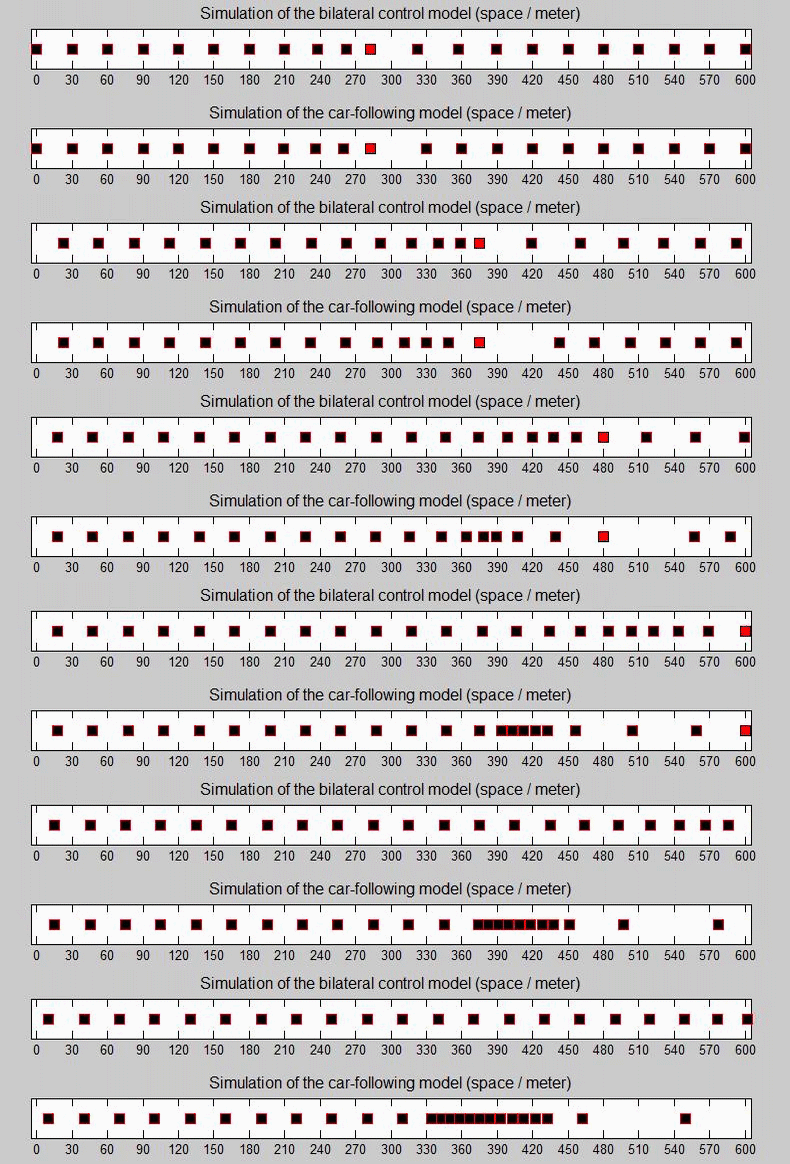 Source: MIT CSAIL