
NASA’s Kilopower Nuclear Reactors Could Power Future Martian Habitats
Eric Olson | November 17, 2017NASA will soon begin testing on a kilowatt-scale nuclear reactor that could serve as the power source for human surface missions on Mars. It could provide electricity for habitats as well as processing equipment to transform Martian ice into oxygen, water and fuel.
Starting in November, NASA will be working with the Department of Energy’s (DOE) Nevada National Security Site to perform testing on the Kilopower project, continuing through early 2018. The reactor will be put through 28 hours of full-power testing in a vacuum environment.
 Credit: NASA Glenn Research Center
“The Kilopower test program will give us confidence that this technology is ready for space flight development. We’ll be checking analytical models along the way for verification of how well the hardware is working,” explains Lee Mason, Space Technology Mission Directorate’s principal technologist for Power and Energy Storage at NASA Headquarters.
The Kilopower reactor will be capable of producing from 1 to 10 kilowatts of power for over 10 years. At its heart is a solid, cast uranium-235 core that generates heat. Transferred via passive sodium heat pipes, the heat is converted to electricity by Stirling engines that generate pressure from heat to move pistons coupled to alternators.
“The reactor technology we are testing could be applicable to multiple NASA missions, and we ultimately hope that this is the first step for fission reactors to create a new paradigm of truly ambitious and inspiring space exploration,” adds David Poston, Los Alamos’ chief reactor designer. “Simplicity is essential to any first-of-a-kind engineering project – not necessarily the simplest design, but finding the simplest path through design, development, fabrication, safety and testing.”
A fission power unit would provide uninterrupted power during periods when other generators such as solar panels halt production.
“A space nuclear reactor could provide a high energy density power source with the ability to operate independent of solar energy or orientation, and the ability to operate in extremely harsh environments, such as the Martian surface,” said Patrick McClure, project lead on the Kilopower work at the Los Alamos National Laboratory.
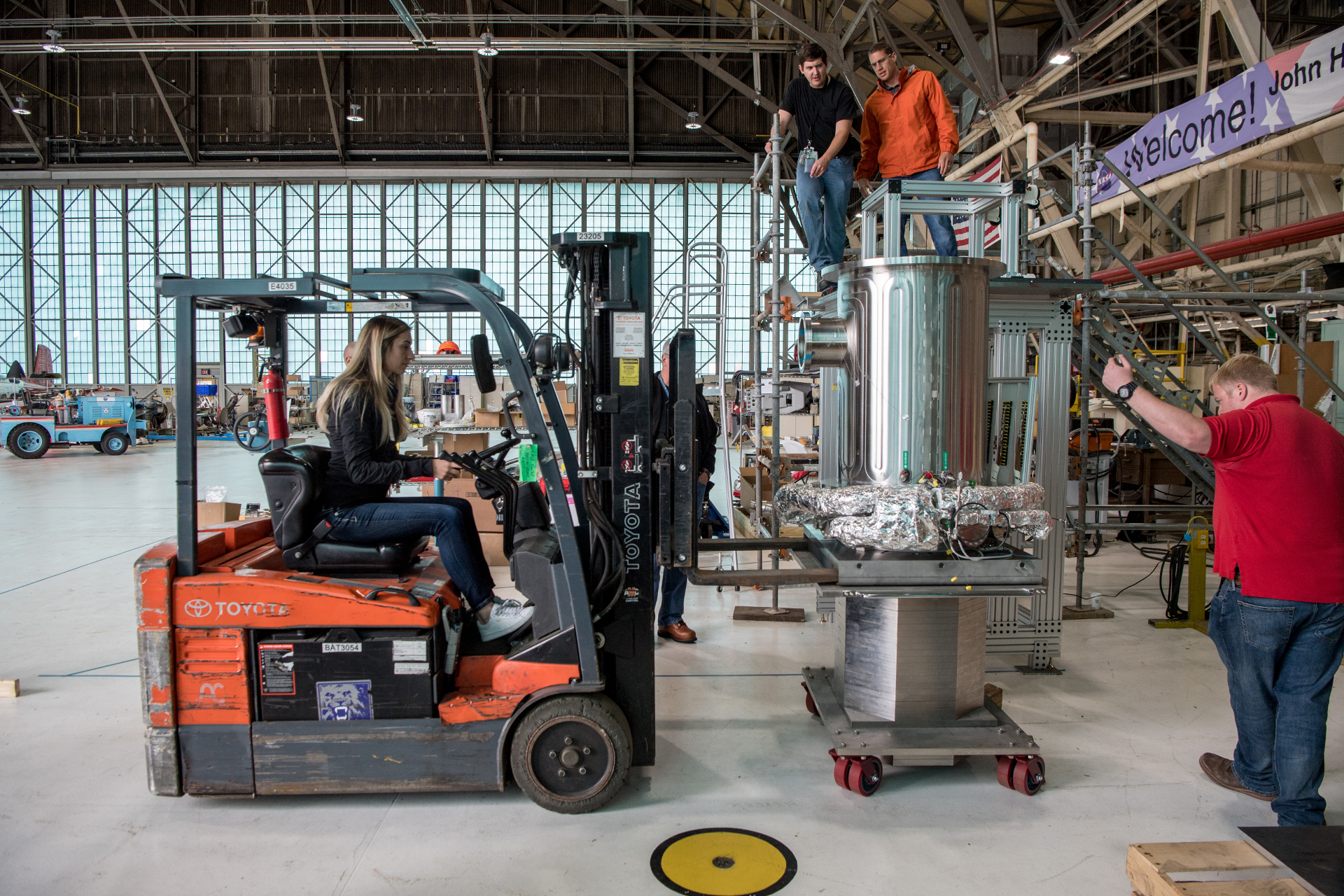 Credit: NASA Glenn Research Center
The dark haze of prolonged dust storms and sunless nights are no barrier to a continuous power source. “It solves those issues and provides a constant supply of power regardless of where you are located on Mars. Fission power could expand the possible landing sites on Mars to include the high northern latitudes, where ice may be present,” Mason said.
The Kilopower reactor will provide power on a greater scale than the radioisotope thermoelectric generators (RTGs) used on several missions over the past fifty years, such as the Curiosity rover exploring Mars and the New Horizons probe that charted Pluto.
“What we are striving to do is give space missions an option beyond RTGs, which generally provide a couple hundred watts or so,” Mason said. “The big difference between all the great things we’ve done on Mars, and what we would need to do for a human mission to that planet, is power. This new technology could provide kilowatts and can eventually be evolved to provide hundreds of kilowatts, or even megawatts of power. We call it the Kilopower project because it gives us a near-term option to provide kilowatts for missions that previously were constrained to use less. But first things first, and our test program is the way to get started.”
The Kilopower project has received funding over a period of multiple years from NASA’s STMD. It is managed by NASA’s Glenn Research Center in Cleveland with support from NASA’s Marshall Space Flight Center in Huntsville, Alabama. In addition, the project has received the support and expertise of the DOE and National Nuclear Security Administration as well as staff at the Los Alamos National Laboratory in New Mexico. The reactor core is provided by the Y12 National Security Complex in Oak Ridge, Tennessee.




Why can't we use these right here on earth? No pesky CO2 "Pollutants.." ?