Watch: AI System for Safer Nuclear Reactors
Tony Pallone | November 09, 2017A system now being developed at Purdue University uses artificial intelligence to analyze videos of nuclear reactors, representing a future inspection technology that can be used to detect cracks, reduce accidents and lower maintenance costs.
“Regular inspection of nuclear power plant components is important to guarantee safe operations,” points out Mohammad R. Jahanshahi, an assistant professor at the Lyles School of Civil Engineering at Purdue. “However, current practice is time-consuming, tedious and subjective… (It) involves human technicians reviewing inspection videos to identify cracks on reactors.” Complicating the issue is that direct manual inspection of a reactor’s components is not feasible, due to high temperatures and radiation hazards. Nuclear reactors are also submerged in water to maintain cooling.
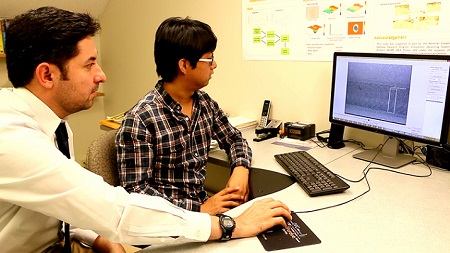 Mohammad R. Jahanshahi, left, reviews results using the new system. Image credit: Purdue University.Cracking, which can lead to leaking, is an important contributing factor in numerous nuclear power incidents, Jahanshahi notes. “Aging degradation is the main cause that leads to function losses and safety impairments caused by cracking, fatigue, embrittlement, wear, erosion, corrosion and oxidation,” he says.
Over a six-decade period, there have been 99 major nuclear incidents worldwide that cost more than $20 billion and led to 4,000 fatalities; 56 of them occurred in the United States – the world’s largest supplier of commercial nuclear power.
But as detailed in a paper appearing in the journal IEEE Transactions on Industrial Electronics, the new system utilizes a deep learning framework to analyze individual video frames, along with an innovative data fusion scheme to aggregate the information extracted from each frame.
Leveraging a dataset that contains around 300,000 crack and non-crack patches, the neural network can be trained to detect cracks in overlapping “patches” in each frame. The data fusion algorithm then tracks a crack from one frame to the next. It is able to account for changing configurations due to the moving camera, thus pinpointing the location of the crack. The algorithm also mimics the ability of human vision to scrutinize cracks from different angles -- important because some cracks are obscured by the play of light and shadow, Jahanshahi notes.
The approach achieves a 98.3 percent success rate. A patent application on the technology has been filed through the Purdue Research Foundation’s Office of Technology Commercialization.