Flexible Photonic Devices Conform to Uneven Surfaces
S. Himmelstein | November 09, 2017Photonic systems use LEDs, lenses and mirrors to process light beams directly. Exploiting light beams rather than a flow of electrons offers advantages for many applications, as optical processing avoids the need for a conversion process.
Most current photonics devices are fabricated from rigid materials on rigid substrates, resulting in an inherent mismatch for uses that require flexibility. Polymers and other soft materials have a low refractive index, which leads to a poor ability to confine a light beam.
An international team of researchers overcame this challenge by transforming a stiff material – chalcogenide 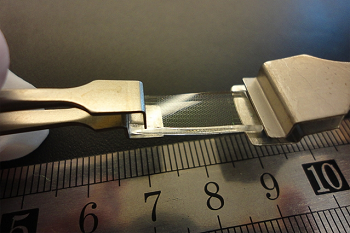 A new material can be repeatedly stretched without losing its optical properties. Source: MIT– into a spring-like coil that can bend and stretch while maintaining its optical properties. The coils are applied directly on a polymer substrate and were demonstrated to withstand thousands of stretching cycles with no detectable degradation in optical performance. Different photonic components interconnected by the flexible, spring-like waveguides were produced in an epoxy resin matrix. The latter was made stiffer near the optical components and more flexible around the waveguides.
The researchers also devised a new way of integrating layers of photonics composed of chalcogenide glass and 2D materials, such as graphene, with conventional semiconductor photonic circuitry. Existing methods for integrating such materials require them to be made on one surface and then peeled off and transferred to the semiconductor wafer, which adds significant complexity to the process. The new approach instead fabricates the layers directly on the semiconductor surface at room temperature, allowing for simplified production and more precise alignment.
The process can also make use of the chalcogenide material as a passivation layer to protect 2D materials from degradation caused by ambient moisture, and as a way to control the optoelectronic characteristics of 2D materials.
Researchers from MIT, University of Texas, Xiamen University and Chongqing University in China, Universite Paris-Sud in France, the University of Southampton in the UK, and the University of Central Florida participated in this investigation.