Machine Learning Predicts Laboratory Earthquakes
S. Himmelstein | September 07, 2017Researchers are making progress in the potential to predict earthquakes by application of machine learning to acoustic signals emitted by a laboratory-created earthquake. Los Alamos National Laboratory scientists demonstrated that by listening to the acoustic signal emitted by a laboratory fault, machine learning can accurately predict the time remaining before it fails.
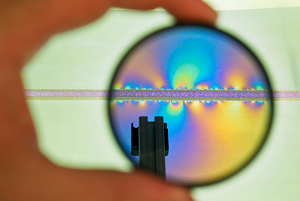 A tabletop simulator is viewed through a polarized camera lens. Photo-elastic plates reveal discrete points of stress buildup along both sides of the modeled fault as the far (upper) plate is moved laterally along the fault. (Source: Los Alamos National Laboratory)This computer science-based approach may also be applicable to all failure scenarios including nondestructive testing of industrial materials, avalanches and other events. The machine learning technique identifies new signals, previously thought to be low-amplitude noise, that provide forecasting information throughout the earthquake cycle.
The algorithms tested can predict failure times of laboratory quakes with remarkable accuracy. The acoustic emission signal, which characterizes the instantaneous physical state of the system, reliably predicts failure far into the future.
Researchers analyzed data from a laboratory fault system that contains fault gouge, the ground-up material created by the stone blocks sliding past one another. An accelerometer recorded the acoustic emission emanating from the shearing layers.
After a frictional failure in the lab set-up, the shearing block moves or displaces, while the gouge material simultaneously dilates and strengthens, as shown by measurably increasing shear stress and friction. “As the material approaches failure, it begins to show the characteristics of a critical stress regime, including many small shear failures that emit impulsive acoustic emissions,” said lead investigator Paul Johnson.
“This unstable state concludes with an actual labquake, in which the shearing block rapidly displaces, the friction and shear stress decrease precipitously, and the gouge layers simultaneously compact,” he said. Under a broad range of conditions, the apparatus slide-slips fairly regularly for hundreds of stress cycles during a single experiment. The signal (due to the gouge grinding and creaking that ultimately leads to the impulsive precursors) allows prediction in the laboratory, with potential for extension to predictions in the Earth.