Cheap Paper Strips Test for E. coli in Potable Water
S. Himmelstein | September 07, 2017A low-cost means of testing potable water for Escherichia coli bacteria returns results in less than three hours. 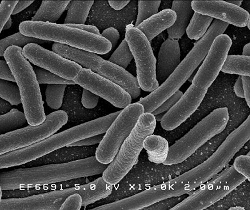 Escherichia coli. Source: Rocky Mountain Laboratories, NIAID, NIHThe technology from the University of Waterloo, Canada, is intended for use in resource-limited communities that can’t afford the $70 cost of current testing platforms.
The water quality analysis is based on paper strips coated at one end with sugar that begins to dissolve when placed in water. E. coli bacteria are attracted by the resulting sugar trail and get trapped in the porous paper. The organisms are carried to a portion of the strip containing a mixture of chemicals. The paper turns pinkish-red as E. coli react with those chemicals, indicating a positive test.
Results are produced in 30 minutes for water supplies with high levels of contamination. Low levels of contamination take up to 180 minutes — at a cost of 50 cents. Work is underway to reduce test times.
The test is being refined by Glacierclean Technologies Inc., a startup company co-founded by one of the university researchers. The assay is also expected to improve water safety in remote or rural areas of the developed world and greatly reduce testing costs for municipal treatment systems.