
Static Electricity Science
Tony Pallone | August 31, 2017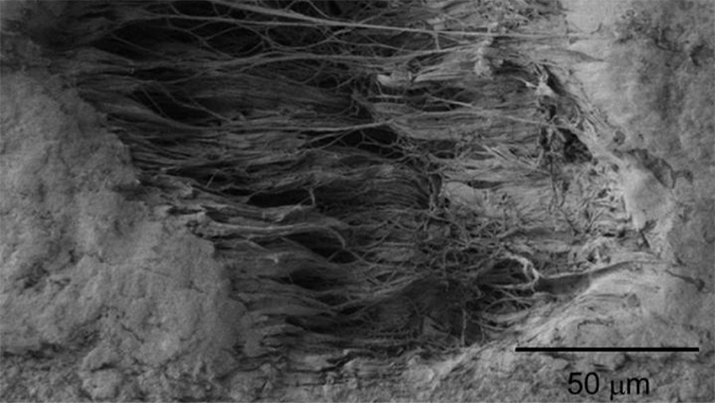 Changes in microstructure appear to control a material's static charge. Source: Case Western Reserve University.
The science behind static electricity, also known as triboelectric charging, used to be fairly cut and dried: a simple transfer of electrons from one material to another creates a static charge; rubbing two materials together can create opposite charges that makes them stick to one another. Minerals have a positive charge, plastics have a negative charge and materials like paper are neutral.
But not long ago, new discoveries threw that science into question: It appeared that static charges could be generated in other ways, such as through chemical processes or by swapping small amounts of actual material. Moreover, a material’s charge could be seen as dependent on a mosaic of positives and negatives, rather than a simple either/or. The long-accepted understanding of the mechanics of static electricity, it seemed, was an oversimplification.
New research from Case Western Reserve University (CWRU) represents a step toward a better understanding of the charging process, however—and may lead to an ability to manage that process for specific uses. Applications could include charged agricultural processes that stick better to plants, or paints that stick better to cars. Better adhesion would also allow material and waste reduction.
As published in the journal Physical Review Materials, the research indicates that changes in the microstructure of a material—tiny cracks and holes—can control how friction works to electrically charge it.
"Our idea was that a strain on the materials was causing a higher propensity for the materials to become charged," said Dan Lacks, chair of the Department of Chemical and Biomolecular Engineering and one of the study's lead authors.
The theory was tested by rubbing together two pieces of polytetrafluoroethlyne (PTFE) film—one stretched to produce strain, and one unstrained. The researchers found a systematic charge transfer in one direction, as if the materials were made of two different chemical compositions. The unstrained films clearly tended to carry a negative charge, and the strained film a positive charge. By contrast, two pieces of unstrained film rubbed together appeared to charge at random.
"Triboelectric charging experiments are generally known for their…charmingly inconsistent results," said Andrew Wang, a Ph.D. student who served as a co-author of the work. "What was surprising to me, initially, was the consistency of the unstrained versus strained charging results."
An analysis of the two films at the atomic level showed nearly-identical results—except that, in the strained film, holes and fractures created by stretching had changed the microstructure of the material. Computer simulations also backed up the theory that the microstructure change was the likely cause of the systematic charge transfer.
"We think the void regions and the fibrils we see around them when we strain the polymer have different bonding and thus charge differently," Lacks explained.
The researchers will next focus on other polymers and granular materials. In addition to exploring ways to utilize the charging process, they are also seeking to increase safety: static charges are capable of causing lethal explosions of coal dust in mines and of sugar and flour dust at food-processing plants. Control of the process could mitigate those effects.
According to Wang, the work might also help future space missions to better handle dust from the asteroids, Mars and the Moon.



Triboelectric experiment conducted successfully and now you guys are thinking to introduce it for the public usage. Read case study essay through topics mill online. It would be less expensive than the general electricity. Thanks for sharing this excellent article about experiment.