Hot Stick Detects DC Voltage in Solar Arrays and EVs
David Wagman | August 22, 2017Researchers at the Department of Energy's Oak Ridge National Laboratory (ORNL) developed a probe to accurately detect direct-current (DC) energy, an area of growing concern with the spread of electric vehicles and rooftop solar arrays.
The DC “Hot Stick” probe designed under the sponsorship of the U.S. Fire Administration detects DC voltage and also helps to ensure that the probe is properly tapped into the electrical lines being tested. This is essential because false negatives may be obtained if a meter is not making proper contact, says ORNL lead scientist Bruce Warmack of the Electrical and Electronics Systems Research Division.
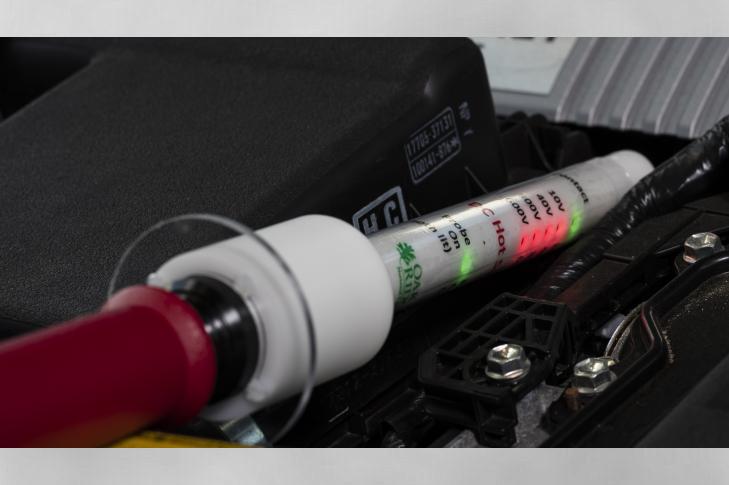 Click to enlarge. The DC Hot Stick voltage probe can accurately detect the presence of DC voltages within a hybrid electric vehicle. Credit: Carlos Jones, ORNL Exposure to these high voltages is increasingly commonplace as technologies such as hybrid cars, EVs and solar panel arrays, all of which contain large amounts of DC power, gain traction. EVs, for instance, may carry as much as 400 to 600 volts, Warmack says. Battery packs are typically situated in the rear of EVs, with electrical cables running to a controller and to other devices.
“If you can imagine in an accident, a vehicle may be splayed open, and first responders need to know whether the car is carrying a charge before they can even touch it, much less cut through cables and extract a victim,” Warmack says. “That much voltage is potentially lethal and can cause arc flash hazards or trigger explosions.”
Similarly, installers and other technicians working on solar panel arrays need protection as well. Those installations can carry several hundred volts, Warmack says.
The probe is designed to penetrate cable insulation and make proven contact with a conductor. The probe then indicates whether a cable is fully discharged of energy.
Making that contact is important. In preliminary work on the project, ORNL researcher Roger Kisner suggested a probe tip verification system that would ensure direct, galvanic contact was made.
One of the challenges for the project was dealing with DC voltage, which is more difficult than AC to work with, Warmack says. “In certain cases, you can get electrical fields from DC, but it is easily interfered with by plastics and other kinds of materials. It’s more or less a science experiment to find DC unless you make direct contact with the conductor using a voltmeter,” he says.
The scientists created a device similar in appearance to most existing AC probes and familiar to first responders. The DC probe can be designed to slip onto the end of an AC probe. A green light indicates proper contact, and if a voltage is detected, a red light is illuminated.
The prototype is already being tested on a first responder vehicle in Frederick County, Maryland, Warmack noted. The Fire Administration has provided positive feedback so far, he said.
Future work could also see the addition of a microcontroller to the probe to give a digital readout and to capture and process data.