
Reusable Water Filter Traps Heavy Metals
S. Himmelstein | July 29, 2017A highly efficient and reusable water filter devised at Rice University removes heavy metals from contaminated 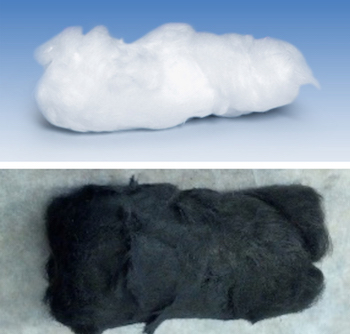 Plain quartz fiber, top, gains the ability to remove toxic metals from water when carbon nanotubes are added, bottom. Image credit: Barron Research Group, Rice Universitywater to meet WHO standards. The filters are composed of multi-walled carbon nanotubes grown on a quartz substrate. Subsequent epoxidation with meta-chloroperoxybenzoic acid provides sufficient functionality to enable adsorption of metals at initial concentrations (60–6000 ppm) chosen to simulate high industrial wastewater contamination.
More than 99 percent of metals from samples laden with cadmium, cobalt, copper, mercury, nickel and lead are removed. Saturated filters can be washed with a mild and common household chemical like vinegar and reused, making the devices suitable for water purification in developing areas.
Scaled-up versions of the filter system were demonstrated to treat five liters of water in less than one minute and be renewed in 90 seconds. The material retained nearly 100 percent of its capacity to filter water for up to 70 liters per 100 grams of supported-epoxidized carbon nanotube. The captured metals can then be extracted for reuse or turned into a solid for safe disposal.
The researchers calculated that one gram of the material could treat 83,000 liters of contaminated water to meet WHO standards—enough to supply the daily needs of 11,000 people.

The last two sentences contradict each other!
The penultimate sentence says 70 liters using 100 grams, while the ultimate says 83,000 liters using 1 gram. Those are vastly different ratios!
Did I miss something?