Harris Uses Proto Labs Insert Molding to Solve Circuit Board Testing Issues
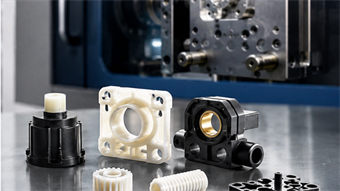
Peter Brown | July 26, 2017 An example of one of the insert molding customizable plastic fixtures used by Harris Corporation for circuit board testing. Image credit: Proto Labs
When Harris Corporation needed to accelerate how they test circuit boards for use in government, defense and commercial segments, it turned to Proto Labs’ insert molding process.
During qualification testing, circuit boards can rest on a vibration test bed for several hours. Harris was finding difficulty determining how best to secure its boards to the large metal plate on the vibration tester.
One way is machining the plate and attaching the circuit board directly to the plates. But this is costly, and the attachment points didn’t necessarily align with those on different boards. So Harris developed plastic fixtures that could hold a number of boards and bolted the fixtures onto the vibration tester. However, problems remained.
In a new white paper from Proto Labs, Harris details how it turned to Proto Labs’ new rapid insert molding service to solve the issue.
Insert molding involves placing a previously formed component into a mold, then injecting thermoplastic into the mold to form the finished part. Metal reinforces the mechanical properties of the plastic and eliminates the need for a secondary process such as heat staking or ultrasonic welding to install the insert into an as-molded part.
In Harris’ case, the insert molding allowed all of the brass inserts to be molded into the test fixtures in one step before they were received, freeing technicians from using a hand-operated thermal press to place each insert individually.
“Obviously, having the inserts molded in the part from the get-go was a huge advantage to us because the parts are ready to go out of the box,” says Michael Murray, principal mechanical engineer in Specialty Applications at Harris Corp.
Murray says using molded-in inserts saves Harris two or more full days of labor by eliminating the process or manually installing the inserts into the test fixtures.
“The net was definitely savings compared to our labor cost,” Murray says. “It was more efficient in our testing as well. I’m able to get started sooner.”
The full white paper can be found on Proto Labs' website.