Coal May Hold Key to REE Supply Security
S. Himmelstein | July 25, 2017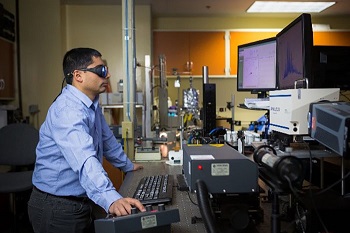 NETL researchers are using laser induced breakdown spectroscopy as one of several techniques to identify rare earth elements present in coal and coal by-products. Image credit: NETL
Rare earth elements (REEs) are a major component in the manufacture of cell phones, computers, batteries and lasers. The Unites States currently imports most of its REE supply, but a domestic source may be right under our feet.
Advanced analysis and characterization techniques under development at the U.S. National Energy Technology Laboratory (NETL) may provide a way to exploit coal resources for REEs. The United States consumes around 16–17 thousand tons of REEs each year and this demand could be met by completely extracting REEs from domestic coal and coal by-products. Methods for sample characterization in the field as well as in the lab demonstrate that REE extraction from coal and coal byproducts can be technically and economically feasible.
Various techniques have been tested, including digestion methods for the accurate determination of trace REE contents by inductively coupled plasma mass spectrometry. This technique minimizes uncertainty in trace REE determination and has also been used to determine the concentration of REEs in Albertan oil sands in Canada.
Other approaches include determining cerium distribution in coal combustion byproducts, rock materials and clays and using geologic interpretation and elemental characterization to identify geochemical markers that help identify high REE zones. REE-containing minerals were also identified in various coal-related materials using advanced microscopic methods.
Use of laser-induced breakdown spectroscopy has solved some of the challenges concerning qualitative detection of REEs in solids, while a fluorescence-based fiber optic-coupled probe integrated with sensitizers showed promise for REE detection at very low concentrations (i.e. parts per million) in aqueous liquids.