
NASA Makes Headway in Developing Quiet Supersonic Passenger Jet
Peter Brown | June 26, 2017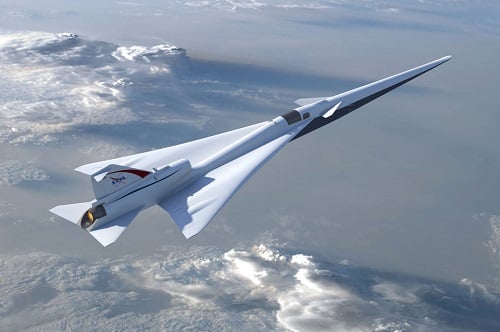 An illustration of the QueSST aircraft. Image credit: NASA
NASA has completed the preliminary design review (PDR) of its Quiet Supersonic Transport (QueSST) aircraft design that could be a lynchpin to changing consumer airplane travel.
The initial design stage of NASA’s Low Boom Flight Demonstration (LBFD) experimental airplane, known as X-plane, would be able to fly at supersonic speeds but create a soft 'thump' instead of the disruptive sonic boom that usually happens. The next step is to fly the X-plane over communities to collect data necessary for regulators to enable supersonic flight over land in the U.S. and other parts of the world.
"Managing a project like this is all about moving from one milestone to the next,” said David Richwine, manager for the preliminary design effort under NASA’s Commercial Supersonic Technology Project. “Our strong partnership with Lockheed Martin helped get us to this point. We’re now one step closer to building an actual X-plane.”
NASA will start the process of soliciting proposals later this year and awarding a contract early next year to build the piloted, single-engine X-plane. NASA says the bidding will be fully open and competitive and after the contract is awarded, flight testing of an LBFD X-plane could began as early as 2021.
To learn more information about X-plane, visit: https://go.nasa.gov/2tdiNif



L-M (and, Boeing, I believe) are working on an even more advanced version for military applications (essentially, the next generation Blackbird). My understanding is that it will have three stages of propulsion, all air breathing, to take the aircraft to Mach 5. As a proposed single engine aircraft, the QUE SST (X-Plane) is probably not more than about Mach 2. The ''quietness'' of the QUE SST is mostly due to its ''form factors,'' but may also include some ''quietness'' tweaks of its engine.
Both aircraft (Mach 2 and Mach 5) likely would have a niche in commercial travel, with the Mach 2 in ''short'' hauls of 5k to 8k km and Mach 5 in everything over 8k km. A five to eight year staggered development schedule to get some solid performance and market experience on the Mach 2 version before going all in on the Mach 5 version would make sense.
When one may ask what NASA is doing in the design of advanced aircraft, as opposed to most of what it has done during its lifetime, the answer is obvious in the first ''A'' of its name.