
A New Method for Reducing Lawn Watering
Marie Donlon | June 20, 2017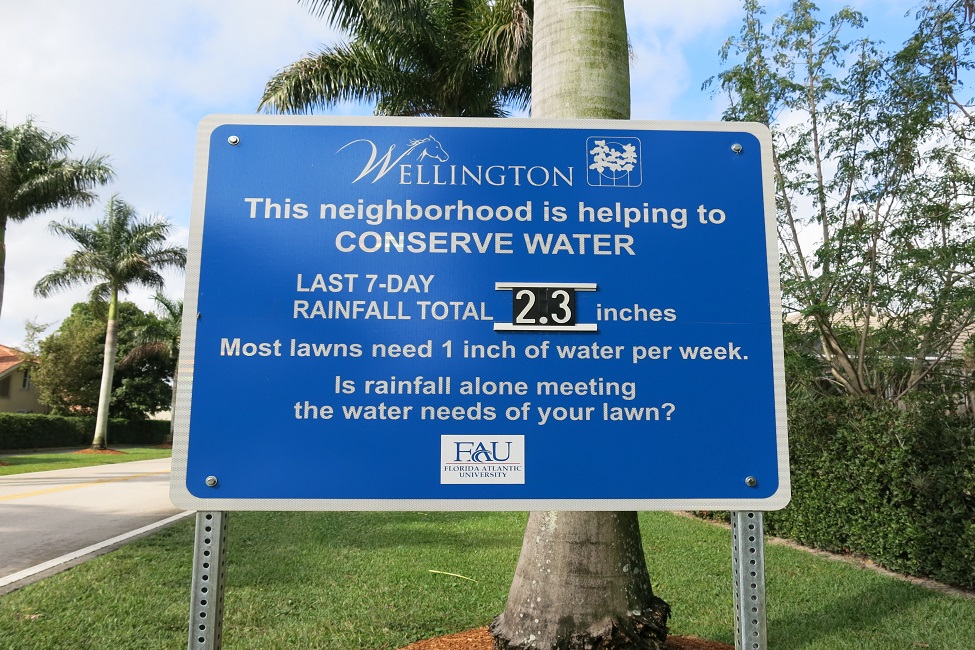 A highly visible road sign and simple communication to hundreds of households in South Florida resulted in an astounding 61 percent decrease in lawn watering in the experimental households as compared to the control group. Image credit: Florida Atlantic UniversityHoping to reduce the amount of water used to maintain lawns and gardens, researchers from Florida Atlantic University are employing an inexpensive tactic to help the cause: a simple road sign.
Because 50 to 90 percent of household water usage alone goes toward watering lawns, it is critical to find a way to conserve water. Commonly used methods to conserve water include implementing watering restrictions such as watering only on certain days or during specific times.
However, current approaches may not go that far in terms of reducing water usage, which is what prompted Tara Root, Ph.D., associate professor in the Department of Geosciences in FAU's Charles E. Schmidt College of Science, and Felicia D. Survis, who recently earned her Ph.D. at FAU, to conduct research on the matter.
Root and Survis conducted research at a suburban village in south Florida exploring methods beyond water restrictions, guidelines and schedules to curb water use.
"The Rain-watered Lawn," a pilot program, was implemented as a weather-based add-on water conservation strategy to find out if informing lawn-watering behavior is more effective than just having mandatory water restrictions alone. The study involved a total of 627 households that were divided into two groups: 321 households assigned to an experimental group, and 306 households assigned to a control group who were subject to only the existing water restrictions.
Researchers erected road signs that both matched existing road signs and that were highly visible informing community members about recent rainfall amounts and the amount of water actually needed to maintain South Florida lawns per week (one inch). The bottom of the sign read: "Is rainfall alone meeting the water needs of your lawn?"
"We would significantly benefit from a new approach to outdoor water conservation to improve how we conserve water and to help people better recognize and synchronize with the regional water balance," said Survis. "People realize that there is something more meaningful that they could be doing to conserve water besides just following a watering schedule, but they have no clear idea about what to do."
As a result of the signage, participants reduced lawn watering significantly (by 61%) during weeks with increased precipitation.
"While this program was especially effective in South Florida, a region with distinct seasonal rainfall, this novel approach developed at Florida Atlantic University is broadly applicable to addressing a global issue in any region to better sync lawn-watering conditions with actual conditions," said Ata Sarajedini, Ph.D., dean of FAU's Charles E. Schmidt College of Science. "This program has the added benefit of getting people more in tune with the natural water cycle, which might help urban and suburban residents prepare for changes in water supply policy that may become necessary as the climate changes."
"With some modifications and use of technology such as texting and the internet, a weather-based outreach project like ours could be scaled up for much larger metropolitan areas," said Root.
The research is published in the Journal of Environmental Management.




Wellington is no where near a typical Florida community. Try Palm Bay, Palm Coast or, best, Deltona.
Your best bet is to plant bahia, mow it no higher than 150 mm, leave the clippings well dispersed and forget about irrigation. Hire a high school kid for a weekend once a year to eviscerate the weeds; Do not use RoundUp. The County USDA agent is a good source for a fire ant poison recommendation (e. g., bifenthrin) for your location and season of application. If you have more than one mound and they are within 15 meters or so of each other, a good heaping shovel full from one mound dumped on another at full mound development may do the job within two weeks or so on the receiving mound.