Safety Testing: Do More Than You Have To
June 06, 2017Sponsored content
As manufacturers design new products, they are challenged to make very certain that the product is safe. For some companies, this means simply being able to pass safety standards. But for some, more progressive companies, there is an opportunity to provide an enhanced level of safety for their customers. These manufacturers also make inroads into preventing faulty components from being installed in their products and into catching workmanship defects in assemblies. Following enhanced safety testing procedures can identify production problems before a product is shipped, preventing costly recalls and embarrassing public announcements.
Many companies are now testing their products for more than the safety standards require. They do not want to risk harming someone using their equipment and the resulting damage to their brand—and possible legal action—when it is entirely preventable with modern test methods. Risk analysis should be a part of any company’s business model. Why ship a product that has a possible user risk factor when it is entirely correctable?
Whatever the reason may be, electrical safety testing makes good sense for any consumer, industrial, transportation, IT equipment, or medical product manufacturer. Testing is done on the production line and on 100% of the product. Setting up an excellent test bench on the manufacturing floor can be quick, reliable, and very cost-effective.
There are, of course, many different safety testing standards around. They are different for different types of products and different countries or regions, but they are all quite similar. A manufacturer needs to test to whatever spec their customers require.
Agencies such as the American National Standards Institute (ANSI), Underwriters Laboratories (UL), CSA Group (CSA), the International Electrotechnical Commission (IEC), and Technischer Überwachungsverein (TUV) provide test and certification standards that ensure electrical or electronic equipment is safe to operate. Manufacturers will want to gain certification from one or more of these agencies.
Note that in the United States, as in many other countries, the federal government isn't involved in regulating these electrical safety compliance agencies—they are self-sustaining and self-regulating. There is not a federal law in the U.S. that states a manufacturer must have an agency approval in order to sell an electrical product. However, in order to compete in today's market and to avoid user injuries and lawsuits, obtaining a safety agency listing is a must.
Another important part of safety testing is documentation. Standards require documentation and traceability for each test. If there is ever a problem with the product, the data can be recalled and examined. This is another area where modern test systems provide a solution, and make it easy, as they collect all the test data, format it, and send it off to a host computer for archiving—plus place it on a local flash drive.
Generally, manufacturers will want to test four things:
AC Hipot and DC Hipot—Stress the product’s insulation with high voltage to ensure that it will limit current flow should a fault occur. Test the isolation between the line voltage and the chassis.
Ground Bond—Verify the ability of the product’s protective earth ground conductor to carry adequate current and prevent electric shock should a fault occur.
Ground Continuity—Verify the presence of your product's low impedance protective earth ground conductor to prevent electric shock should a fault occur.
Leakage Current— Earth leakage measures leakage current through product insulation while the DUT is running. It can also measure leakage through various insulation barriers such as between patient leads or patient lead to chassis point.
Whereas older test setups used separate instruments for each test, modern equipment can do it all with one instrument. Instruments like the HypotULTRA 7804 and 7854 from Associated Research will perform all four of these tests automatically. They offer easy programmable setup using their touch-screen interface and the user can then save the test sequence for exact replay.
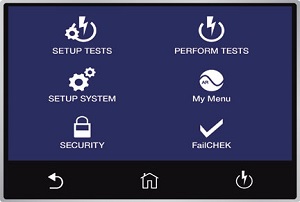 Fig. 1: Touch-panel setup is usable even with a gloved hand.
Both of the instruments have an internal power source providing up to 6,000 volts dc and 5,000 volts ac. They feature a compact 22 in. x 22 in. x 9 in. footprint and will record the result of each programmed test step. Each test can be set up with a high/low limit to ensure proper qualifications for each unit under test. On this page (www.arisafety.com/products/hypotultra/), you will find a quick start guide for the 78x4 that gets you running a full test in just three PDF pages.
Nick Piotrowski, Product Manager at Associated Research, said that “Customers use the 7804/54 as an all-in-one solution for safety testing. With the capability for on-board data storage and direct connection to a barcode scanner, customers simply scan the product and the HypotULTRA automatically runs the proper sequence and saves all testing data. Not only does this greatly cut down on total production time, it provides confidence that all tests are properly run and data automatically saved.”
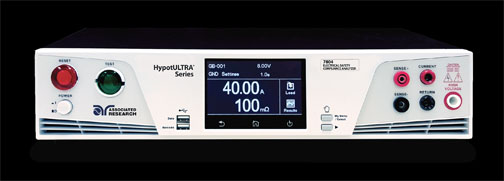 Fig. 2: The front panel of the HypotULTRA 7804.
The HypotULTRA 7854 features the ability to perform a 40 Aac ground bond test, aiming to adopt the highest level of testing without sacrificing productivity. Both versions have a feature called DualCHEK that allows the user to run a hipot and ground bond test simultaneously for faster production throughput. The instruments can also increase production throughput by incorporating a barcode scan that will associate the unit under test with the test sequence and test data. The barcode scan also supports concatenated barcodes. The testers have a USB port and an optional Ethernet port and they can even use multiple languages for their operator interface.
An external scanner can also be added for up to 16 additional channels of high-voltage and/or high-current connections. It allows for multi-point hipot and/or ground bond tests.
Another thing to be mindful of is operator safety. While high-voltage outputs are current limited, operator safety is still critical. Safety accessory kits are available and the instruments have a remote safety interlock connect on the back panel that can be used with a unit under test safety enclosure. The Select Safe Workstation package includes dual remote palm switches and an insulation mat.
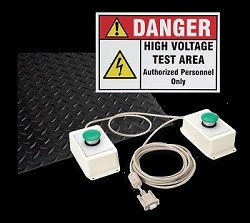 Fig. 3: Select Safe Workstation package.
  Fig. 4: Premium Safe Workstation package.
Manufacturers can also include product functional testing in the process, which can add greatly to confidence in the product's field performance and have a significant impact on reducing product returns. For this, the OMNIA II Series instruments, with a variety of automation interfaces, fits the bill.
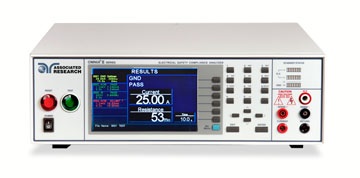 Fig. 5: The OMNIA II 8207 front panel.
The OMNIA II 8207 and 8257 instruments have an internal power source. Multiple operational measurements can be made of voltage, current, power, power factor, or leakage with high/low monitoring over a very broad range of values.