Running Shoes May Not Degrade as Quickly as Previously Thought
Marie Donlon | May 24, 2017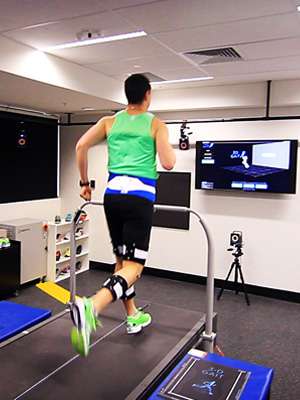 “Our goal is to find out how to elicit a better design, to create a product that interacts better with the people who wear it.” (Source: Deakin University)Think you have hit a limit with your running shoes and need to buy a new pair? According to a collaborative study from Deakin University's School of Engineering and School of Exercise and Nutrition Sciences, running shoes don’t wear out as much as previously thought.
Measuring running-shoe durability using humans instead of machine testing, Dr. Paul Collins, from the School of Engineering, and Dr. Jason Bonacci, from the School of Exercise and Nutrition Sciences, found “that shoes degrade initially up to 25 percent of energy absorption effectiveness, but then they plateau."
"The degradation of the ethylene vinyl acetate (EVA) occurs very rapidly and then settles. Despite this rapid change in shoe properties, it had no influence on participants' running styles. Therefore, we think that runners can continue to use their shoes until other signs of shoe wear occur, such as deterioration of the rubber outsole or upper fabric," said Dr. Collins.
Twelve participants took part in the study, which looked at the runners in 90-minute testing sessions both before and after the participants had each run 200 kilometers.
"While participants were running on the treadmill, we examined their running kinematics and kinetics with our 3-D motion capture system," explained Rory Purdie, a researcher with Deakin's Centre for Sport Research.
"By using retroreflective markers on participants' lower bodies, we collected data, monitoring changes in angles of joints, measurements of generated force and time taken to get through different segments of their stride," she said.
Although no significant changes to participants’ gait were discovered, testing at 25 kilometers revealed the patterned deterioration of the shoe materials.
"The mid-sole foam of EVA breaks down all the weak bonds in the first 25 kilometers. From there on, it's solid material compressing on solid material, without the air bubble. While it can only compress so far, you do see a fatigue style of the mechanism of the material," said Dr. Collins.
Researchers suggest that the rate at which people replace their running shoes may have more to do with fashion than function.
The collaboration between Dr. Collins and Dr. Bonacci is ongoing with the release of 3-D printed shoe models planned for later this year.