Energy-Harvesting Laser Phosphor Display
Peter Brown | May 03, 2017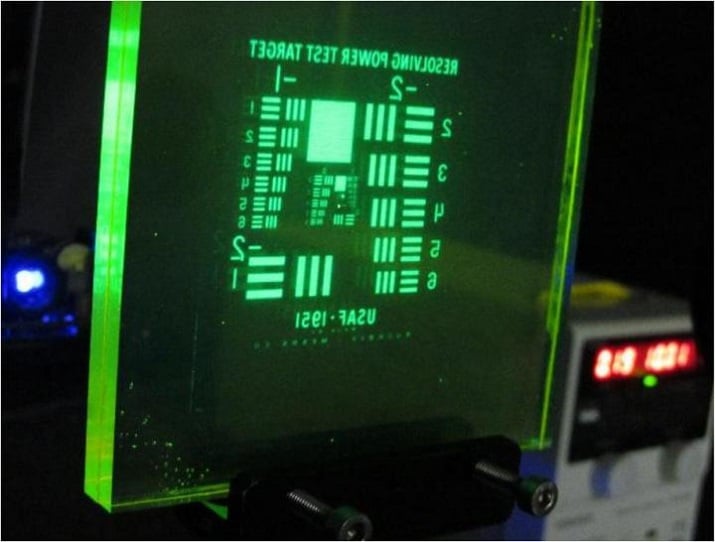 The resolution test chart display on the phosphor screen. Image credit: SPIE
Researchers at SPIE, the international society for optics and photonics, have developed a way to harvest energy from ambient light by replacing the phosphor screen in a laser phosphor display (LPD) with a luminescent solar concentrator (LSC).
The concept experiment was developed by fabricating a 95 x 95 x 10 mm screen and sandwiching a thin layer of coumarin 6 with two transparent plates. The plates guided the photoluminescent (PL) photons emitted in both directions toward their edge surfaces. The researchers removed the light source from a DMD-based commercial grade projector and then fed a blue laser beam into its optics. The results were a screen that generated green images.
The display was able to harvest up to 71 percent of the incoming optical power, however a ghost image was noticeable when displaying a high-contrast still image.
In the experiment, researchers found that extracting the PL photons in each module reduces the thickness of a large-area system, improving the self-absorption. For seamless tiling, attaching an output coupler to the wave guiding plate and mounting solar cells provides an optimal solution, researchers say.
The ghost image is the PL photons reflecting at the interface between the rear plate and the outside environment. Reducing the thickness in the rear plate of the LPD, researchers were able to eliminate the optical cross-talk.
The project shows that luminescent solar concentrators for display applications can be used in a pratical way and is a starting point for improving the design to work in better ways, SPIE says.
The complete findings of the experiment can be found in the Journal of Photonics for Energy.