Fast Method for Synthesizing Critical Concrete Additive
Nancy Ordman | April 27, 2017A new method for synthesizing tobermorite, a mineral that increases concrete durability, speeds up production times from days to hours and results in a product that is a better replica of natural tobermorite.
Tobermorite is present in Roman concrete, specifically in the cement that holds concrete together. The American Ceramic Society has confirmed that the mineral contributes to concrete longevity, making it a desired
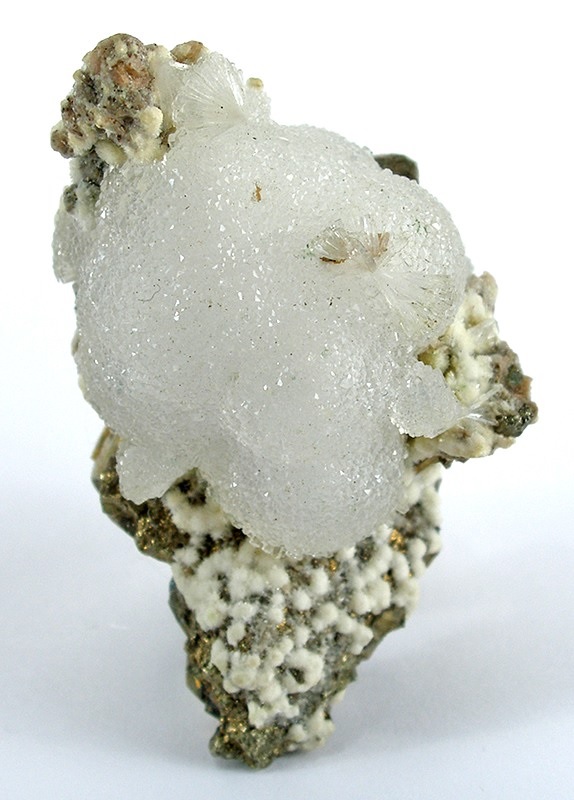 Tobermorite crystal. Source: iRocks.com, CC-BY-SA-3.0 additive for modern concrete manufacture.
Since natural tobermorite is not abundant, effective and efficient processes for its synthesis are of great interest. The current method synthesizes tobermorite using hydrothermal methods at moderate temperatures. Drawbacks of this method include its the time consuming nature of the process and the less-than-desirable physical properties of the resulting mineral.
Collaborative research by scientists at Technalia, in Spain, and France’s ICMCB-CNRS developed a fast, high-temperature synthesis process for nano-tobermorite. The researchers reported that they obtained nanofibers of tobermorite in water under high temperature (400 degrees Celsius) and high pressure (235 bar) within 10 seconds. The product more closely resembles natural tobermorite.
The research results were published in Angewandte Chemie, where the editors designated it a “very important paper.”