Selective Solar Absorber Takes the Heat
S. Himmelstein | April 06, 2017An off-the-shelf silicon wafer has been modified by Purdue University researchers to withstand temperatures approaching 535° C (995° F) without losing stability or performance. The re-engineered selective solar absorber can be used in concentrated solar power plants and other high-temperature solar thermal technologies.
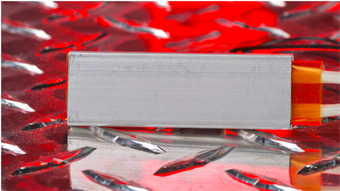
The silicon solar device, composed of an upper layer of an anti-reflection coating of silicon nitride and a back reflective layer made of silver, facilitates absorption of incident solar radiation without re-radiating excessive heat. High selectivity of the device is obtained at temperatures as high as 490° C (914° F), and mechanical and thermal stability is documented even at slightly higher temperatures. A 2-in. silicon wafer coated with thin films of tantalum and silicon nitride for enhanced solar absorption. Image credit: Purdue University/Zhiguang Zhou
Extending previous work, the team developed a detailed model that simulates how the material properties change with rising temperatures. The model helped researchers design the structure built from silicon wafers, and led to the discovery that a selective absorber made of thin films of silicon can exhibit even higher performance. The absorber is expected to feature thermal transfer efficiencies of 60 percent-70 percent at solar concentrations of 20-100 suns.
Because the thin films are flexible, they can be applied to curved structures such as the mirrored parabolic troughs used for concentrated solar power systems. With 50 suns concentration produced with parabolic troughs, it is possible to convert 51.5 percent of sunlight into usable, high-grade heat at 490° C (914° F).
The long-range goal is to incorporate all of the components into a working system for continuous generation of electricity. Such systems might find applications for both large-scale power generation and small residential systems.