Equipment Tailored for Supercritical Concentrating Solar Power
Engineering360 News Desk | April 02, 2017Supercritical carbon dioxide (sCO2) power cycle technology is being advanced by GE Global Research (GE) and Southwest Research Institute to improve the economics and performance of concentrating solar power systems (CSPs).
Instead of using steam to power an electric generator, sCO2 is heated to temperatures greater than 700 °C to drive a turbine and create electricity.
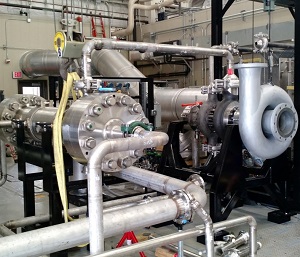 The DOE SunShot loop is designed to demonstrate highly efficient turbine expander and recuperator performance for advanced sCO2 CSP cycles. Photo courtesy of Southwest Research InstituteRelative to a traditional CSP plant, the sCO2 power cycle generates more electricity for a given amount of heat, improving plant efficiency and lowering the cost of electricity. Smaller turbines can be deployed, resulting in less material utilization and lower upfront capital costs.
With U.S. Department of Energy SunShot Initiative funding, the researchers developed a high-efficiency s-CO2 hot-gas turbo-expander for the sCO2 Brayton cycle. The equipment is being tested with the flow of sCO2 to mimic real-world, variable generation scenarios at the MW scale and to ensure that it performs as expected under load conditions.
GE has also developed prediction models to validate the long-term reliability of hybrid gas bearings and dry gas seals needed to ensure the 30-year lifetime required for the turbomachinery. An optimal compression system is being designed to help a sCO2 power block consistently operate under a range of temperatures and pressures.
The engineering team will be joined by Gas Technology Institute in designing, building, and demonstrating a 10 MW pilot facility in San Antonio, TX. This new facility has the potential to demonstrate greater than 50% percent cycle efficiency while bringing the sCO2 power cycle closer to commercialization.