Hydrogen Test Project Set for Steelmaker
Engineering360 News Desk | February 08, 2017The European Commission awarded the H2FUTURE project consortium--consisting of voestalpine, Siemens, VERBUND and Austrian Power Grid (APG) as well as the research-partners K1-MET and ECN--the contract for the construction of one of the world’s largest electrolysis plants for producing green hydrogen. The project-partners will work and research cooperatively on implementing an innovative hydrogen demonstration plant at the voestalpine site in Linz.
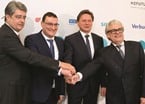 Venture partners at the project announcement.The EU’s climate and energy goals stipulate a 40% reduction of CO2 emissions by 2030, which poses almost unsolvable problems for energy-intensive industries, the project partners say. Green Hydrogen produced based on CO2-free green electricity presents "enormous potential" for use as an industrial process gas, as well as for energy storage.
The Fuel Cells and Hydrogen Joint Undertaking (FCH JU) allocated about 12 million EUR ($12.83 million) in funding from the EU Horizon 2020 program to implement this project with the goal of producing green hydrogen. The hydrogen will be produced in an electrolyser with proton exchange membrane (PEM) technology. The total project volume amounts to about 18 million EUR over the course of 4.5 years.
The plant will be built and operated on the premises of voestalpine in Linz. The hydrogen generated there will be fed directly into the internal gas network, allowing the testing of the use of hydrogen in various process stages of steel production.
The technology supplier for the proton exchange membrane electrolyser is Siemens. VERBUND, the project coordinator, will provide electricity from renewable energy sources and is responsible for development of grid-relevant services.
Further partners in the project are the research institution ECN from the Netherlands , which is responsible for the scientific analysis of the demonstration operation and the transferability to other industrial sectors, and the Austrian transmission system operator APG, which will provide support in integrating the plant into the power reserve markets. The Austrian COMET Competence Center K1-MET provides its expertise in the operation of the plant and demonstrates the potential applications in the European and global steel sector.
With H2FUTURE, key questions about sector coupling will be handled, such as evaluating potentials and possibilities for using green hydrogen in various process stages of steel production. In addition, the transferability of this technology to other industrial sectors which use hydrogen in their production processes will be investigated.
A further focus is integrating the responsive PEM electrolysis plant into the power reserve markets by developing demand-side management solutions, thus compensating for short-term fluctuations in the increasingly volatile power supply by means of load management for bulk consumers.