Lithium Recovery from Oil Brine
Engineering360 News Desk | January 25, 2017Canadian mining company MGX Minerals Inc. has successfully used its patent pending process to extract lithium from heavy oil wastewater.
Results are part of the ongoing optimization for completion and deployment of a pilot plant in support of its 487,000 hectare Alberta lithium project.
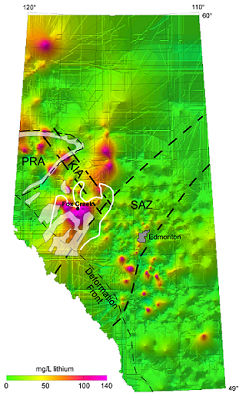 Shaded contour map of lithium-bearing formation waters in west-central Alberta. Source: ERCB/AGS Open File Report 2011-10The extraction technology, claimed to be the first of its kind, reduces production time of lithium from brine by 99% compared with conventional production times that use solar evaporation. Process time is reduced from approximately 18 months to 1 day using MGX's process.
Project specifications and results:
- Starting EBD with Li concentration of 87 mg/L.
- Final recovery of Li was 34.8 mg/L or 40%.
- Li was lost in the initial softening of the EBD (18%) when approximately 20% of the fluid mass is lost due to removal of silica and other solids,
- 1% of the Li was lost in the NaCl removal step.
- 16% of the Li was lost in the magnesium removal step.
- 4% of Li was lost in the CaCl2 removal step.
- 21% of the total Li remained in the final brine. This portion of lithium has a high probability of recovery by further reaction or during a second pass.
- Li was crystallized as lithium carbonate.
- Other primary recoveries of minerals in total were 83% sodium and 100% calcium.
- The final brine still contained high concentrations of sodium, potassium, and boron indicating where optimization will focus on.
- Additional applicable data was collected for the potential extraction of boron, bromine, magnesium and potassium.
- The treatment process removed all suspended solids, 99.97% of the hydrocarbons and reduced scale forming ions such as silica to levels suitable for reuse in steam generating processes.
A byproduct of steam assisted gravity drainage during heavy oil production, heavy oil evaporator blowdown wastewater (EBD) was targeted as it contains mid-level concentrations of lithium and has the potential to generate high environmental revenue based on current disposal costs.
MGX is working with Alberta, Canada-based PurLucid Treatment Solutions, a developer of nanofiltration technology, to integrate their respective technologies and develop a pilot plant to provide oil sand producers with additional environmentally-friendly disposal options as well as recover valuable minerals such as lithium.